Fall 2026
Volume VI, Issue I
- Published
- In this issue
- 10 papers
- 134 pages
Contents
Editor’s Note
A New York Times article from September 2026 calls to attention a mismatch in the present decade: “One one side, warnings of existential risk, maybe a 10 percent chance of the end of civilization. One the other, government paralysis.” The piece further elaborates that, similar to Albert Einstein’s letter to Franklin D. Roosevelt in 1939 about the potential development of powerful atomic bombs, more than 1,300 computer scientists issued a stark warning in July of 2026 about the rapid, unregulated proliferation of artificial intelligence (A.I.), urging government intervention and oversight. Technological change may well be inevitable, yet the pace of these shifts are what can be controlled. This human agency is the foundation of Volume VI, Issue I of the Prism Youth Journal of History and Social Sciences.
The contemporary A.I. dilemma is not our first encounter with rapid technological change or institutional adaptation. In light of this matter, the Prism Editorial Board compiled a selection of ten history papers focusing on the mid-to-late 20th century, written by students at Milton Academy and Shanghai High School. By examining how 20th-century societies navigated state power, civil liberties, and international diplomacy, this issue provides critical context for the structural challenges of the 21st century.
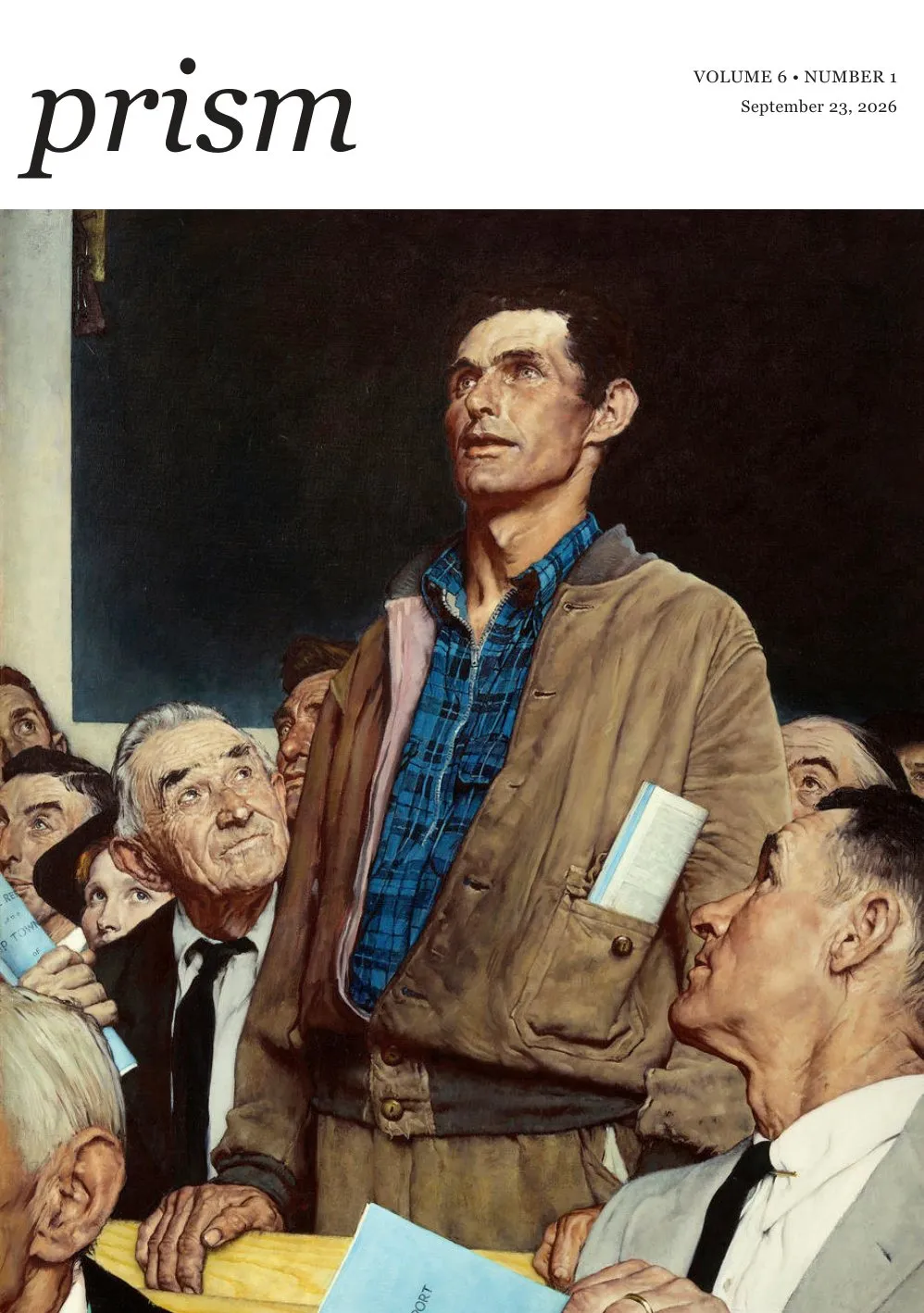
Research about MK Ultra and McCarthyism by authors Emmett Burghardt (Milton Academy ’27) and Lyra Dvorin (Milton Academy ’28), respectively, demonstrate how Cold War anxieties led government entities to compromise civil liberties through espionage or ideological suppression. This focus on power and public welfare extends into domestic policy debates. William Lara McCannon’s (Milton Academy ’28) paper on National Healthcare analyzes the reasons and effects of President Harry S. Truman’s failed national healthcare plan, during a time rampant with fear of communism and shift in racial constructs. Indeed, Chingmou Zhou’s (Shanghai High School International Division) piece on the Voting Rights Act examines its effectiveness on ensuring electoral representation and long-term civil rights. Media and culture also played a pivotal role in shaping public perception during these volatile decades, and Niamh O’Donoghue’s (Milton Academy ’28) paper on Norman Rockwell demonstrates how popular art captured political beliefs and social change.
On the global stage, much of the mid-1900s centered on ideological confrontation and interventionism. An analysis by Rhys Adams (Milton Academy ’26) covering the USSR, China, and Cuba explores how tripolar communist dynamics reshaped global alliances. The real-world consequences of the influence of these global superpowers, including the United States, is illustrated in Amy Khaing’s (Milton Academy ’27) essay on the U.S. Interventions in Chile. Lucas Xia’s (Milton Academy ’28) paper about the Truman Recognition of Israel traces the origins of enduring diplomatic frameworks. Molly O’Brien’s (Milton Academy ’26) paper on the roots of the Israel-Palestine Conflict dives into the intricacies of foreign policy and human conflict. Documenting these conflicts from the front lines were journalists, as highlighted in Riley Qiu’s (Milton Academy ’28) paper on Female War Correspondents during World War II—women who broke gender barriers and redefined human-centered journalism.
The structural patterns that define history always endure to the present day. Whether evaluating the Cold War intelligence operations of the mid-20th century or the artificial intelligence boom of the 21st century, the underlying question remains unchanged: how do societies construct resilient, ethical governance in the face of volatility or destabilizing change? Our collection of papers does not offer a clear solution, but it provides essential insights to navigate the modern age. On behalf of the entire Prism Editorial Board, we invite you to engage with these works not solely as records of the past, but as vital lenses to shape our collective future.
Yours sincerely,
The Editors-in-Chief
Emlyn Joseph, Ezra Chen, and Vivienne Mockenhaupt
Masthead
-
Editors-in-Chief
-
Head of Layout
-
Editorial Board
-
Layout Board
-
Faculty Advisor