Art History
Creating the Cliché: How Norman Rockwell Defined America in the 20th Century
Summary
Draft summaryThis paper traces how Norman Rockwell moved from the idyllic but limited American Dream of his Saturday Evening Post covers to the photojournalistic civil rights paintings he made for Look magazine. Through readings of “The Problem We All Live With,” “Southern Justice” and “Murder in Mississippi,” it argues that Rockwell asked Americans to consider not only how they wanted to be depicted but who they wanted to be.
Norman Rockwell was one of the key defining artists of America. His iconic style was easily identifiable by his signature, almost caricature-like subjects of boy scouts, young love, and seemingly infinite paintings of similar patriotic scenes. Rockwell was a standout artist in the American timeline by his ability to encapsulate such a wide variety of perspectives in his decades-long career with two different magazines. Beginning in the Great Depression and continuing long into the 1970s, Rockwell wrapped up the American Dream into neat, magazine-cover-sized packages for the average consumer with The Saturday Evening Post. The Post’s covers, while idyllic, were only representative of a fraction of the American population. This limited American Dream was confined to his work with The Saturday Evening Post; during his time with Look magazine, his paintings became increasingly realistic, aligning with the change in discussions that were occurring along the political landscape. Credentialed by two magazines on opposite sides of the spectrum, Rockwell’s traditional, accessible style allowed him to reflect on both the national reaction toward the civil rights movement and the nostalgic feel of memories experienced by many citizens. As his style evolved from nostalgic fantasy, he turned an increasingly photojournalistic eye towards events in the South. Through depicting the humanity of his subjects, he invited the viewer to assess treatment of their fellow people on their own terms.
Continuously critiqued throughout his career as a clichéd, common artist, Rockwell did not need to be validated by the modernistic, expressionist style of his era because, in mirroring the childhood memories of America, his work grew to be loved by millions. In a tumultuous world during and after World War II, the artistic community within America rejected traditional, realistic art such as Rockwell’s. As artists and their critics wanted a “new art of meaning and substance,” abstract expressionism took hold as the new popular style amongst fine artists. Often characterized by a cacophony of colors and textures, abstract expressionism helped artists communicate feelings and doubts in a way that felt aligned with just how chaotic the world had become. Thus, Rockwell’s steadfastness in his iconic style was dismissed by artists as being lowbrow due to its apparent lack of nuance in a rapidly changing landscape.
However, Rockwell’s mainstream audience through The Saturday Evening Post stood unwavering against the torrent of criticism from fine artists. As he stated in an interview, “I love to tell stories in pictures… that isn’t what fine art man goes for.” Rockwell’s art hinged on ideas that were inherently “antithetical” to abstract expressionism, based on an easily accessible story instead of a mix of patterns and colors that were often unintelligible to the untrained eye. Unlike artists, the vast majority of Americans—particularly those in the South—clung to the patriotic and pre-war memories associated with Rockwell. They had no need for the affirmations of stuffy critics so long as they felt comforted by Rockwell’s paintings, proving “mass taste doesn’t need any votes. It has already won the race.” Clichéd as it may have been, Rockwell’s ability to make his audience feel truly seen made him exceptionally popular. Rockwell built up his dependable reputation with the American public into a robust platform for the rest of his career with The Saturday Evening Post. By 1940, Rockwell had firmly established himself as an artist of the people, for the people. By representing “the America [he] knew and observed to others who may not have noticed,” after World War II, Rockwell served as an interpreter of how Americans were perceived and how they wanted themselves to be perceived. His work, as one fan wrote, was “a part of Americana… when the world was a nice and cozy place to live in.” His contract with The Saturday Evening Post affirmed exactly what Americans were looking for—a source of comfort during a challenging time.
One stipulation that came with being the definition of Americana, however, was that Rockwell could depict the American Dream only for a select group of people. Due to his contract with The Saturday Evening Post—a conservative magazine and the distributor and sponsor of his works—Rockwell was heavily encouraged by his editors to never paint people of color and was forbidden to paint them in any roles other than that of servants. However, despite these rules, Rockwell still managed to depict people of color by “sneaking them in” against the wishes of his employers. Despite his working around the rules, only a handful out of over 300 of his covers with The Saturday Evening Post were people of color ever depicted.
By the 1950s, as word of the civil rights movement had made its rounds to his small New England town, Rockwell began to feel trapped by The Post’s restrictions on his subject matter. As an artist who depicted the common ideas that were in the minds of Americans, he could no longer ignore the changes brewing on the horizon. The “best of all possible worlds— grandfathers, puppy dogs—things like that” were “dead now, and [he thought it was] about time.” Rockwell was now grappling with a complicated world. Despite his growing resentment toward The Saturday Evening Post, Rockwell had still established a positive reputation, particularly with conservative white Americans in the South through his time at The Post. To abruptly move away from his pattern of soothing the American people would potentially be detrimental to his fan base. Despite the risk to his carefully curated reputation, he began to pull himself away from The Post and focus on the changing political landscape leading up to the Civil Rights Movement.
After his time at The Post, Rockwell moved onto Look magazine, a popular liberal magazine that gained particular traction for its coverage of the civil rights movement. Look was significantly more liberal than The Saturday Evening Post, citing coverage of a variety of perspectives within its issues, especially during the civil rights movement. There, Rockwell stipulated that he would have complete creative freedom over the sources and the content of his paintings, which would prove to be influential in the progression of his distinct style. In alignment with the shift from pre-war memories to current events, he began to paint powerful photojournalistic scenes. However, because the majority of his audience were white Americans, they were “caught off guard by the artist’s change in subject matter,” nonetheless a necessary realization for the coming years. His work throughout the civil rights movement proved not only to be reflective of the national shame of the backlash through his works such as “The Problem We All Live With” and “Murder in Mississippi,” but also hopeful for the future, such as in “New Kids in the Neighborhood.” During his time at Look magazine, his works blossomed to interact directly with the viewer. By being legitimized by both Look magazine and The Saturday Evening Post, Rockwell had established himself a robust platform on which he could truly showcase both sides of American history with “intimated authenticity.” No longer was the viewer spoon-fed a narrative; they were now urged to interpret his paintings based on where they stood on the political spectrum. Through this style, his work directly reflected the nation’s shift from clinging onto the pre-war fantasy to addressing the civil rights movement. He encouraged the viewer to grapple with moments that “evoked both the nation’s ideals and its realities.” As an artist who defined how Americans saw themselves, Rockwell reflected on America’s reaction toward the civil rights movement, a bold step in that he asked viewers to grapple with the question of how they wanted to be seen as opposed to how they were behaving in reality through Rockwell’s photojournalistic lens.
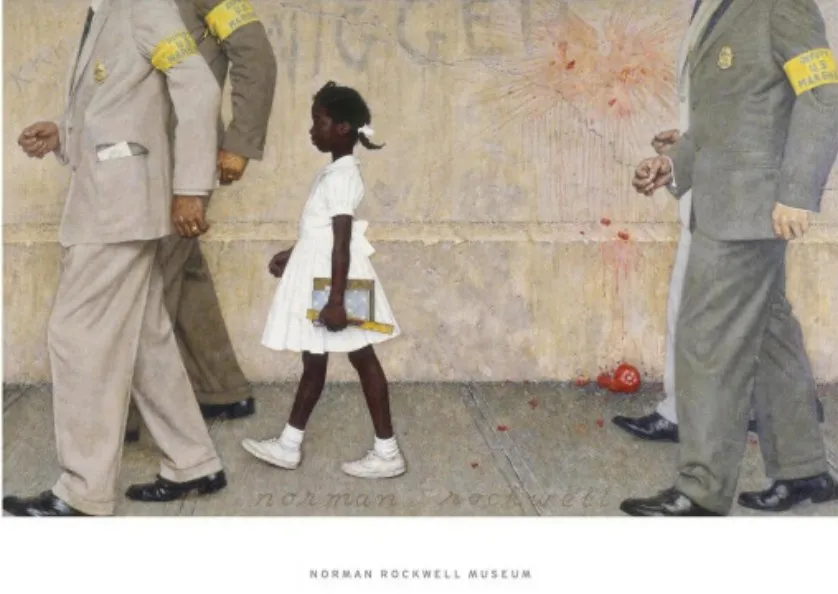
Norman Rockwell’s “The Problem We All Live With” forced the viewer to grapple with the complexities of the desegregation of Alabama’s schools while humanizing Bridges, further confronting the nation with their own actions through his photojournalistic style. “The Problem We All Live With” was an immense accomplishment by Rockwell from the start, spanning nearly four feet in diameter. A smaller version of the painting was published by Look magazine in their issue reflecting on the desegregation of Alabama’s schools. Even so, when published, it reached across an entire magazine page spread, capturing its audience’s attention immediately. Rockwell ensured that, regardless of how temporary or informal magazines were considered, when displayed, “The Problem We All Live With” would live up to the gravity of the event it depicted. In addition to the painting’s scale, the painting’s perspective challenges the viewer with the complexities involved in the scene; the viewer is watching Ruby Bridges’ walk to school from within the crowd of spectators and screaming adults—but at a child’s height, eye level with Bridges. Rockwell’s use of perspective in this painting not only exposes the viewer to the plain facts of the event, but also preserves Bridges’ humanity. Despite the thrown tomato beside her and the racist slur scrawled on the wall, her unstained white tennis shoes march on fearlessly as she clutches her notebooks. The viewer is unable to see her face beyond her side profile, not even giving the crowd a glance as she makes her way to the first day of kindergarten, undoubtedly the main character of this scene. By utilizing perspective with his realistic style, Rockwell ensured that the viewer did not see eye-to-eye with the US marshals surrounding her, nor with the white supremacists, but with Bridges herself. Rockwell confronts the viewer, and therefore America, as not a spectator of the scene, but as a participant.
In addition to protecting Bridges’ dignity in “The Problem We All Live With,” Rockwell’s hidden details demonstrate the painting’s vagueness to the viewer. Even though “The Problem We All Live With” is firmly a photojournalistic painting aimed to address the backlash toward Bridges’s walk to school, not only does it confront America with their own reactions to the event, but also leaves it up to the viewer to reflect upon its titular phrase as far as they are willing to go. Bridget Cooks in “Norman Rockwell’s Negro Problem” argues that “the most pressing and open-ended questions the painting prompts are: What is the problem we all live with? and Who are we?” At first glance, it is easy to write off the title as simply another one of Rockwell’s strategies to aid the viewer in how to interpret the painting. However, the juxtaposition between the ambiguous title and stark imagery was a powerful contrast to Rockwell’s previous works. Before his time at Look magazine, Rockwell mirrored America’s latching onto the past as a source of comfort; by leaving the responsibility of finding the true meaning behind a seemingly simple painting, Rockwell allowed Americans to reflect on their own actions. “The Problem We All Live With” also addressed the “quasi-liberalism” that Northerners had continuously been perpetuating. Coined by Dr. Martin Luther King Jr., this quasi-liberalism was a “liberalism that is so objectively analytical that it is not subjectively committed,” proving detrimental to advancements toward civil rights because, while these liberal Northerners had sympathy for those in the South, in failing to address the racism in their own hometowns, they lacked the fortitude to carry out actions of change. Rockwell, in referring to the problem as a collective one by using “We All,” called for unity to address such acts of violence. In alignment with the complex emotions that riddled America’s pop culture and were reflected in its art, America could no longer use Rockwell as a crutch to help them process their emotions toward historical events. This painting toes the line between interpretation and fact: the blatant hatred and racism toward Bridges, questioning just who this problem is for, either just Southerners or for America as a whole.
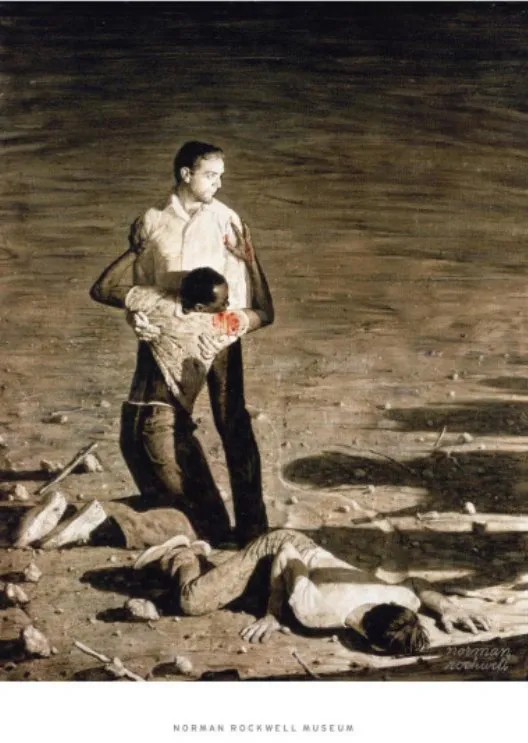
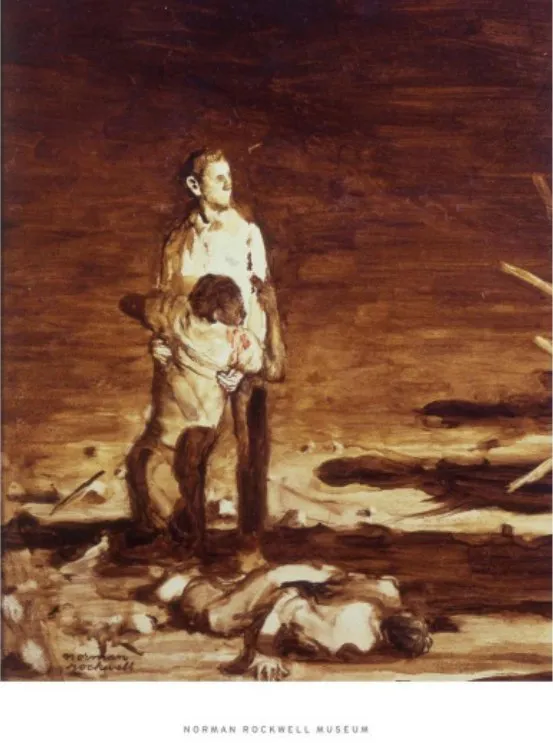
Just as with “The Problem We All Live With,” Rockwell’s later works focusing on the direct violence as a result of the civil rights movement even further shifted away from his previous, obvious meanings behind his paintings. While works such as “Southern Justice” still held a glaringly obvious center event, no longer was there a direct storyline associated with the painting waiting to be uncovered; rather there was a truth waiting to be unraveled through a snapshot of current events. Rockwell’s paintings of the South, previously hallmarks of the hazy, nostalgic images that millions related to, turned a corner with “Murder in Mississippi;” Rockwell demonstrated that, from a Northern perspective, along with quasi-liberalism, the rest of the nation was no longer relying on pre-war memories and was now turning their attention to the more current issues plaguing the South. One of these issues was the relationship between the North’s use of Southern violence as a “deflector of national guilt” and the backlash from the Southern states. Just as with “The Problem We All Live With,” Rockwell used the title to highlight not details of the painting itself, but rather the context behind it. However, though Rockwell’s initial sketch for Look magazine, “Southern Justice,” was a poignant example of the national shift in perception, the final, polished painting lacked the key details that were so striking. “Murder in Mississippi,” while it did indeed provide necessary context to the viewer, confined the concept of violence simply to a specific state, not to the South as a whole; as a result, “all that anger that was in the sketch had gone out of it.” On the other hand, using “Southern Justice” as the titular phrase effectively communicates the complete opposite. Rockwell asks the viewer just what is considered acceptable for violent acts during the civil rights movement, especially because “the term “Southern Justice” is apt in that it connotes something quite different from the idea of ‘American Justice.’” Violence in the South at the time was often written off as simply “Southern Justice,” the excuse that racial violence was bound to occur, under the pretense that such events never happened in the North. Rockwell set aside this Northern attitude and pushed past the barriers that kept the North dismissive of violence in the South. Rockwell addressed the whole nation by referring simply to the South, emphasizing the double standards between the North and the South and bringing in themes of liberalism from “The Problem We All Live With” to consolidate the ever-strengthening divide between two different worlds.
These paintings, while they are only a few pieces in the puzzle that make up Norman Rockwell’s legacy, are simply a few examples of how his works were shaped to fit the timeline they were created in. Rockwell’s almost mirror-like capabilities in highlighting details that were overlooked and the reach of his talent across America through both his style and magazines shaped how Americans identified themselves during a turbulent time. He challenged and comforted the population through both World Wars, the civil rights movement, and everything in between. Even in the twenty-first century, his paintings are still being interpreted by a variety of different perspectives. His patriotic paintings from the beginning of his career, for example, were taken by the Department of Homeland Security without his family’s permission and used to perpetuate hateful rhetoric against immigrants; to his surviving family, this interpretation lacked the “nuanced approach” that Rockwell originally intended. The Department of Homeland Security, in using Rockwell’s paintings, used his work to their advantage, trying to revive, as his granddaughter put it, “a segregationist past.” The Department of Homeland Security’s use of Rockwell’s paintings, while a controversial one indeed, exemplified just how interpretable his works were. On the other hand, former president Barack Obama requested for “The Problem We All Live With” to be hung in the West Wing of the White House, inviting Ruby Bridges herself to view it and speak with Obama. An absence of a “nuanced approach” was inevitable with any work of visual art, and that absence truly portrays the diverse opinions America has for itself and for Rockwell. These two examples of just how differently Rockwell’s paintings are still interpreted in the modern age exemplify how applicable Rockwell’s art was to the American people. Combining countless layers of meaning behind his seemingly simple paintings and cozy style allowed decades of Americans to pick and choose how they wanted to be seen. A timeless artist, Rockwell captured a broad spectrum of political beliefs into a single lifelong career; through his later years, by questioning his readers with the question of not only how they wanted to be depicted, but who they wanted to be, Rockwell welcomed the complexities of such an intricate political and cultural spectrum.
Appendix
Citations
- Apatoff, David. “The Art of the Post: How Norman Rockwell Got the Last Laugh.” Saturday Evening Post, April 17, 2019. Accessed March 22, 2026. https://www.saturdayeveningpost.com/2019/04/the-art-of-the-post-from-derided-to-desired-how-norman-rockwell-got-the-last-laugh/.
- Borgwardt, Elizabeth. “FDR’s Four Freedoms as a Human Rights Instrument.” OAH Magazine of History 22, no. 2 (2008): 8-13. http://www.jstor.org/stable/25162165.
- Cooks, Bridget R. “Norman Rockwell’s Negro Problem.” Cultural Critique 105 (2019): 40-79. https://doi.org/10.5749/culturalcritique.105.2019.0040.
- Detrow, Scott. “Relatives of late artist Norman Rockwell push back on DHS use of paintings.” November 14, 2025. In NPR. Podcast, audio, 5:00. Accessed April 2, 2026. https://www.npr.org/2025/11/14/nx-s1-5604700/relatives-of-late-artist-norman-rockwell-push-back-on-dhs-use-of-paintings.
- Doss, Erika. “Makes Me Laugh, Makes Me Cry.” American Art 25, no. 3 (2011): 2-8. https://doi.org/10.1086/663948.
- Finch, Christopher. Norman Rockwell’s America. Nachdr. ed. Abrams, 2008.
- Foner, Eric. The Story of American Freedom Eric Foner. Papermac, 2000.
- Greenhill, Jennifer A. “The View from outside.” American Art 21, no. 2 (2007): 70-95. https://doi.org/10.1086/521890.
- Jansson, David. “The Work of Southering.” Southeastern Geographer 57, no. 2 (2017): 131-50. https://www.jstor.org/stable/26367654.
- King Jr., Martin Luther. “Give Us the Ballot.” Speech presented at Prayer Pilgrimage for Freedom, Washington, D.C. Martin Luther King, Jr. Research and Education Institute. Stanford University. Last modified May 17, 1957. Accessed March 11, 2026. https://kinginstitute.stanford.edu/king-papers/documents/give-us-ballot-address-delivered-prayer-pilgrimage-freedom.
- “Look Magazine Photograph Collection.” Library of Congress. Accessed April 15, 2026. https://guides.loc.gov/american-women-prints-photographs/photojournalism/look-photo-collection.
- Malones, Ligaya. “An Artist in His Studio: The Enduring Vision of Norman Rockwell.” National Trust for Historical Preservation. Accessed March 9, 2026. https://savingplaces.org/stories/an-artist-in-his-studio-the-enduring-vision-of-norman-rockwell.
- Norman Rockwell, The Problem We All Live With, 1963, oil on canvas, 36 x 58 inches. Illustration for LOOK, January 14, 1964. Norman Rockwell Museum Collections.
- Norman Rockwell Museum Video. Narrated by Norman Rockwell. Norman Rockwell Museum.
- Paul, Stella. “Abstract Expressionism.” The Met. Last modified October 1, 2004. Accessed April 2, 2026. https://www.metmuseum.org/essays/abstract-expressionism.
- “The Real Story Behind Norman Rockwell’s 1964 Painting ‘The Problem We All Live With.’” Rare Historical Photos. Accessed March 8, 2026. https://rarehistoricalphotos.com/norman-rockwell-the-problem-we-all-live-with/.
- Rockwell, Norman. Murder in Mississippi. 1965. Oil on canvas. Norman Rockwell Museum, Stockbridge, MA. Accessed April 8, 2026. https://prints.nrm.org/detail/502591/rockwell-murder-in-mississippi-southern-justice-1965?srsltid=AfmBOopPp70cg0dWUuStpgnFOUoEk4aSxn9-n29EUs4tLD14OhcvTVBo.
- Rockwell, Norman. New Kids in the Neighborhood. May 16, 1967. Illustration. Accessed March 11, 2026. https://prints.nrm.org/detail/281625/rockwell-new-kids-in-the-neighborhood-negro-in-the-suburbs-moving-day-1967?srsltid=AfmBOoqPBmH4561Sdt4XdSKKqKitfqiozyXBjH-nHyO47glTE44h8BuT.
- Rockwell, Norman. Southern Justice. 1965. Oil on canvas. Norman Rockwell Museum, Stockbridge, MA. Accessed April 8, 2026. https://prints.nrm.org/detail/499705/rockwell-murder-in-mississippi-1965?srsltid=AfmBOorZlErvpjK5K3nZBqsC-S22OfKCV7szCmQ5QAlE0lvVEQmYw6V3.
- The Rockwell Family. “We’re Norman Rockwell’s family. Trump’s DHS has shamefully misused his work. | Opinion.” USA Today, November 2, 2025. Accessed April 3, 2026. https://www.usatoday.com/story/opinion/voices/2025/11/02/norman-rockwell-trump-dhs-anti-immigrant-social-media/86949410007/.
- Solomon, Deborah. “In Praise of Bad Art.” New York Times Magazine, January 24, 1999. Accessed April 9, 2026. https://www.nytimes.com/1999/01/24/magazine/in-praise-of-bad-art.html.
- Souza, Pete. President Obama Views Rockwell’s “The Problem We All Live With.” July 15, 2011. Photograph. Accessed April 16, 2026. https://obamawhitehouse.archives.gov/photos-and-video/photo/2011/07/president-obama-views-rockwells-problem-we-all-live.
- Theoharis, Jeanne. “What King Said About Northern Liberalism.” New York Times (New York City), January 20, 2019. Accessed March 13, 2026. https://www.nytimes.com/2019/01/20/opinion/martin-luther-king-new-york.html.
- Rockwell, Norman. Triple Self Portrait. 1960. Oil on Canvas. Norman Rockwell Museum. Accessed April 17, 2026. https://prints.nrm.org/detail/261054/rockwell-triple-self-portrait-1960.