History
Why Don’t We Have National Healthcare?
Summary
Draft summaryThis paper asks why President Harry S. Truman’s proposal for national health insurance failed, and finds the answer in Jim Crow segregation in the South, the rising fear of communism and the opposition of the American Medical Association. It argues that although the plan paved the way for Medicare and Medicaid in 1965, its failure meant that later programs had to be framed as charity rather than as aid to the middle class.
Millions of our citizens do not now have a full measure of opportunity to achieve and enjoy good health. Millions do not now have protection or security against the economic effects of sickness. The time has arrived for action to help them attain that opportunity and that protection.
— Harry S. Truman, remarks to Congress, 1945
Seven months after adopting the presidency on April 12th, 1945, Harry S. Truman proposed his universal healthcare insurance program. Due to the status quo, his plan failed spectacularly. As president, Truman fiercely advocated for improving general welfare, a belief outlined under five pillars: increasing physician retention in rural communities, improving maternal and child care, bolstering investment in medical research and education, addressing the exorbitant cost of medical care, and alleviating the financial loss incurred by illness. Truman hoped that his national healthcare plan, which covered pillars four and five, would mean that “whether or not patients get the services they need would not depend on how much they can afford to pay at the time.” The issue of affordability was supremely relevant; at the time, healthcare was limited to either the richest, due to the high out-of-pocket costs, or to the poorest, who relied on charity care for treatment, leaving the middle class uncovered. Truman vowed to change this system, “trying to fix it so the people in the middle income bracket can live as long as the very rich and very poor.” Unfortunately for Truman, the state of affairs in the United States obstructed his intended progress. The South’s Jim Crow segregationist system, the rising fear of communism, and a belligerent American Medical Association (AMA), unaccustomed to government intervention, created a feedback loop that degraded the public support for the national system, ultimately causing its demise. While Truman’s plan enabled the implementation of Medicare and Medicaid in 1965 during Lyndon B. Johnson’s presidency, its failure encouraged President Johnson to focus on charitable policy which avoided addressing the middle class and destroyed the possibility of creating social service programs in America.
The end of World War II, on September 2nd, 1945, spurred the beginning of a tumultuous period for America that was defined by the ambiguity between facism, communism, and democracy. The Third Reich was itself a paradox. On the one hand, the German democratic state’s abrupt transformation into a fascist regime – emblemized by the Holocaust’s killing of more than six million innocents – exposed the world to the dangers of government overreach and unchecked prejudice. On the other hand, it established social services: old age insurance, educational reforms, and public health programs. Now, for the first time, people questioned the validity of popular pseudo-sciences, such as Social Darwinism, which were the basis for racial discrimination. As Ruth Benedict put it in her book, Race and Racism, racism is “a travesty of scientific knowledge,” and, out of the embers of the war, communism emerged as an appealing alternative to the crushing individualism and discrimination of capitalism. “Communism is completed naturalism is humanism and as completed humanism is naturalism,” said Karl Marx, highlighting communism’s aim to abolish class divisions and establish a fundamentally fair, human society. The Soviet Union, ruled with Joseph Stalin’s iron fist, became the only nation comparable in military might, ideological prowess, and international authority to the United States. Their competition for economic and social superiority set the stage for the Cold War. In response, America—threatened by Russia’s zealous promotion of their communist agenda by influencing foreign affairs—created the Truman Doctrine in 1947. The United States designed the policy to contain the spread of communism by directly supporting “free peoples who are resisting attempted subjugation…by outside pressures,” intertwining the two powers in a “Great Power Conflict” that sought ideological domination. The Cold War motivated Senator Joseph McCarthy’s (R-WI) anti-communist crusade, creating a “Red Scare” in which America was gripped by the fear of communism. Locked in a geopolitical battle of principle, the US was put under a spotlight; as Truman put it, “the free peoples of the world look to us for support in maintaining their freedoms.”
The establishment of the National Health Service (NHS) in the United Kingdom exemplified the circumstantial reasons why universal healthcare failed in the US but succeeded in Britain. The end of WWII left England devastated: millions of homes damaged, critical infrastructure destroyed, rationing that continued even post-war, and economic depression that crippled the nation. The harsh circumstances catalysed a change in British thinking. Much like how Franklin D. Roosevelt (FDR) promoted his “four essential human freedoms”—‘freedom of speech, freedom of worship, freedom from want, and freedom from fear’—Britain broadcasted its mission to tackle the ‘Five Giants’: “Want, Disease, Ignorance, Squalor and Idleness.” Suddenly, national healthcare became morally imperative. The post-war enlightenment prompted scrutiny of human rights in the United Kingdom. In his 1952 book In Place of Fear, United Kingdom Minister of Health Aneurin Bevan declared that “no society can legitimately call itself civilized if a sick person is denied medical aid because of lack of means,” commentary that highlighted England’s progressive political ideology.
As such, the success of the NHS establishment in 1948 is largely due to the social, economic, and political environment of the country at the time. The British Medical Association “was psycho-logically prepared for universal health care,” having provided for half the population under a plan for low-income individuals 36 years beforehand. Further, by covering 85% of the costs with general revenue, the plan left the taxpayers relatively unaffected. Britain’s government “exercise[d] stronger control over details,” as it was not troubled with maintaining states’ rights. Finally, the UK’s homogeny – only “5.5 percent of the population” was part of “ethnic minorities” – meant that the nation lacked racial tension. This combination of factors led to the plan’s “acceptance by all leading politicians in this country,” as noted former-PM Attlee. Britain succeeded because the people needed National Healthcare: the social deprivation emphasized the importance of healthcare as a human right, meanwhile Britain’s political structure let the NHS pass easily. Yet for every reason the UK triumphed, Truman was hindered by an onslaught of opposition that destroyed any hope for universal healthcare in America.
Segregation’s entrenchment in Southern society could never coexist with universal healthcare; success meant the destruction of a Jim Crow system that had thrived for centuries. Truman’s point of failure was the South’s silver bullet: the United States’ sacred obligation to ‘states’ rights.’ The 1896 Supreme Court case Plessy v. Ferguson heralded an era of condoned white superiority by stating that “if one race be inferior to the other socially, the Constitution of the United States cannot put them upon the same plane.” This racial divide manifested itself in Southern segregation, where all “public spaces and entertainment venues” remained divided. Although enforced by consistent violence—”the southern states account[ed] for nine-tenths of the lynchings,” the return of over 1.2 million African-American GIs caused a resurgence in brutality. However, the issue began earlier. Passed in 1935, FDR’s Social Security Act, among other benefits, provided old age insurance. Fearing Black’s would move away from lower-paying jobs, Southern Democrats, exercising their Congressional power, excluded agricultural laborers and domestic servants – 60% of the Black workforce – from the Act. Because the idea of an empowered Black working-class scared Southerners, the GI Bill, which offered free college tuition, loan assistance, unemployment insurance and more, caused “many whites [to fear] that returning Black veterans would upset the racial status quo.” In addition to resurging violence, the GI Bill’s implementation being delegated to states allowed Southerners to deny Blacks their benefits. Whites built “homes with racially restrictive covenants … a practice known as exclusionary zoning,” which kept Blacks out of favorable neighborhoods, and incidentally, meant that “factories, oil refineries, municipal dumps, and the municipal incinerator [ended up] on blocks with Black resi-dences.” So given that the New Orleans City Commission claimed “poor health conditions go hand in hand with poor housing facilities,” being Black in the ‘30s and ‘40s was fraught with danger: The African-American experience resulted in 60% of insurance companies denying them coverage, ironically, citing higher risk. The result was a wealth ratio of eight to one, whites to Blacks, in 1940. Even though Black soldiers were promised protections, the federalist system preserved Jim Crow by delegating power to state legislatures, a measure the South abused. So when Truman proposed his national healthcare plan, Southern delegations responded with the force of the times.
The GI Bill and Executive Order 9981’s enactment left Congress feeling that increased government involvement threatened federalism; as a successor to these actions, Truman’s healthcare proposition – also known as the Wagner-Murray-Dingell bill – strained existing racial and intragovernmental tension, provoking fierce bipartisan opposition. Passed by Truman in 1948, Executive Order 9981, as described by Ebony Magazine, was the “swiftest and most amazing upset of racial policy in the history of the U.S. military.” Truman’s action came in response to America’s international humiliation; led by W.E.B DuBois, the NAACP brought forth to the recently-established UN its Appeal to the World, a testimony to the United States’ paradox:
a great nation, which today ought to be in the forefront of the march toward peace and democracy, finds itself continuously making common cause with race-hate, prejudiced exploitation and oppression of the common man. Its high and noble words are turned against it, because they are contradicted in every syllable by the treatment of the American Negro for three hundred and twenty-eight years.
While more symbolic than effective, Truman, with the stroke of his pen, had disrupted four centuries’ worth of social norms; when he proposed his healthcare plan, it represented executive overreach that attacked both Republican and the Southern Democratic ideologies. The fiscally conservative Republicans disliked Truman’s financing the system with 3% “contributions,” as they believed “taxes are taxes.” They believed that Truman’s plan was the last domino in a chain of prior legislation enacted that imposed the government on individual liberties. Southern Democrats agreed as well, given how dramatically these executive orders – such as E.O. 9981 and the GI Bill – threatened to change the very fabric of Jim Crow; so because Truman’s healthcare plan would have desegregated the hospital system, it was a life-or-death situation for Southern Democrats. The status of the South’s hospital structure illustrates the drastic change Southern Democrats feared.
The South detested Truman’s healthcare policy because it meant the reversal of a heavily segregated healthcare system, resulting in a disintegration of Jim Crow laws. The South had the worst healthcare system in America; in 1940, Surgeon General Thomas Parran called the South “[t]he number one health problem of the Nation;” yet for Black Americans, the situation was much worse. Only 6% of Southern Hospitals were fully integrated while 47% allowed access to segregated wards – often in basements or attics – and 31% denied admission outright. The rest, all-Black hospitals, were limited in number and drained in resources: “In sixteen southern states 9.7 million African Americans were served by 79 black hospitals, most of which were unaccredited, underequipped, and struggling to remain open.” This utter lack of adequate facilities caused “the urban black death rate [to be] 95% higher than that of the urban white population.” Truman’s statement, in which he details that “the benefits of modern medical science have not been enjoyed by our citizens with any degree of equality…unless government is bold enough to do something about it,” indirectly targets Southern segregation as an issue for governmental reform. Therefore, a byproduct of affirming national healthcare would result in tangible, legal “equality”: true integration through the destruction of Plessy v. Ferguson segregation. So while Southern whites and Blacks both endured health issues, according to Paul Krugman, “[k]eeping Black people out of white hospitals was more important to Southern politicians than providing poor whites with the means to get medical treatment.” To fix this problem while simultaneously protecting Jim Crow, Congress employed the Hill-Burton Act.
Passed in 1946, the Hill-Burton Act, which “launched the Nation on the most comprehensive hospital and public health construction program ever undertaken,” was a bipartisan effort to circumvent the Wagner-Murray-Dingell bill. The Hill-Burton Act sought to appease the public, who supported Truman’s plan. In 1945, “Gallup found 59% of Americans… favored the plan,” suggesting dissatisfaction with the current healthcare system. The Republican rationale, led by Harold Burton (R-OH), addressed the population’s distaste: the sparsity of hospital beds. The Southern Democratic focus, championed by Lister Hill (D-AL), fiercely advocated for the autonomy of state legislatures “to set policy without federal interference.” Yet, most interestingly, the Act was the only 20th century legislation to include a segregation clause, specifying “that discrimination on the basis of race was acceptable if there was ‘equitable provision…for each such group.”’ Southern Democrats had bypassed Truman’s plan, bolstering the US’ healthcare system while preserving Jim Crow. The South put the segregation clause to good use: “65/67 Alabama counties used Hill-Burton money to build hospitals that were segregated.” Furthermore, even though “20 percent of projects aided teaching hospitals, including the burgeoning new academic medical centers,” these universities were segregated, which kept physician education in Black communities stagnant. But even with separate wards and doctoral schools, the ingeniousness of the Hill-Burton Act was that it actually benefited the Southern Black population: “Southerners of both races, but blacks particularly, began to enjoy an access to modern hospital care that they had never known before.” The increased access to care created a schism in the progressive Black diaspora, which had “long engaged in a dialectic between separatism and integrationism.” Some Blacks supported the Act’s benefit to African-American health regardless of segregation, while others, notably the National Medical Association—the Black alternative to the AMA—viewed it as a setback in the fight for integration. The Hill-Burton Act, in addition to alleviating the internal pressures, had an international impact, displaying America’s commitment to humanity which improved the US public image, critical during the Cold War. The Hill-Burton Act also allowed Congress to engage with public support for improved healthcare while simultaneously enforcing segregation in the South and dividing the Black opinion.
The AMA—of which 75% of physicians were members—disapproved of Truman’s plan because they perceived it as a threat to physician autonomy. Even though Truman emphasized repeatedly that “Socialized medicine means that all doctors work as employees of government…[but] No such system is here proposed,” more than 70% of physicians opposed the plan on the basis of losing physician autonomy; and what is what doctors control best but who they chose to treat. The AMA, being itself ‘whites only,’ implies’ that desegregation would inhibit doctors from discriminating against patients based on race. In response, they launched a massive advertisement campaign to counter the proposal, using the nation’s fear of communism to its advantage.
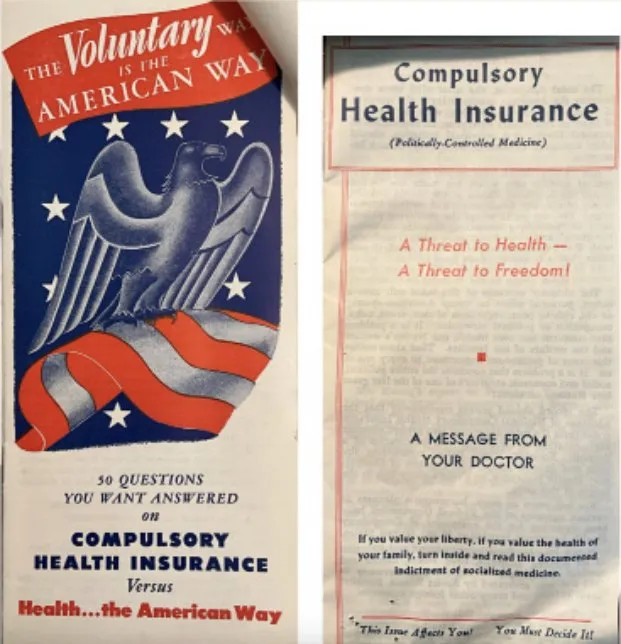
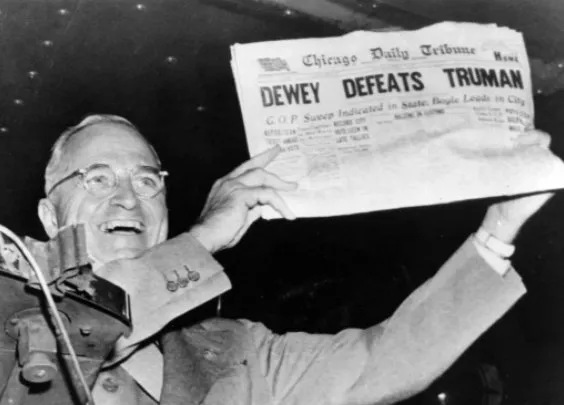
Partnering with Whitaker and Baxter’s (WB) Campaigns Incorporated, the AMA charged their physicians an extra $25, spending $1,500,000 on advertisement in 1945 alone. AMA-disseminated pamphlets focused on universal healthcare’s link to socialist and fascist regimes. One pamphlet asked: “Would socialized medicine lead to socialization of other phases of life? Lenin thought so. He declared socialized medicine is the keystone to the arch of the socialist state.” Supporting the AMA’s stance was that Hitler had implemented national healthcare in Germany as well: Friederich Hayek, an Austrian economist and philosopher, asserted that “by giving the government unlimited powers…a democracy may set up the most complete despotism imaginable.” According to Hayek’s philosophy, not only was Truman’s plan purportedly communist, but a step towards totalitarianism; and given that Americans were particularly sensitized to issues surrounding their freedoms, reeling from the end of the deadly World War, every government action was scrutinized tenfold. The AMA, both partaking in and using public fear, published numerous pamphlets and cartoons that ingrained in American minds that they must choose “The American Way” over Truman’s “socialized medicine” (see figure 1). By shifting the rhetoric and establishing the narrative that single-payer insurance was “American,” the AMA thought it had silenced the issue…but Truman’s massive presidential upset in 1948 (see figure 2), in which he defied all odds to beat Thomas Dewey, resparked the national healthcare debate.
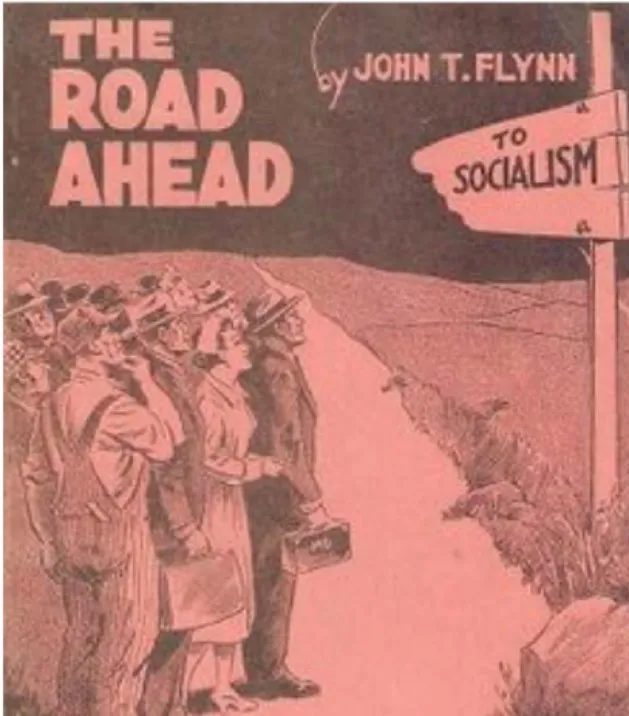
The AMA deemed Truman’s reelection an “Armageddon Moment” because of the NHS’ precedent-setting establishment, the Democratic majority in Congress, and national healthcare’s still high approval rate. In response, AMA quickly mobilized and partnered with over 1,800 organizations to use the status quo to appeal to the public. One strategy involved redoubling efforts to frame Truman’s plan as communist. Comics (see figure 3) forced a narrative in which national healthcare resulted in American socialism. Senator Taft (R-OH), among other Congressmen, also cited communism: it is “the most socialistic measure this Congress has ever had before it.” The threat of communism was convenient for racists, too, as for Black people. One person noted that“[to speak] out forcefully for civil rights was to risk being branded a ‘Commie.’”
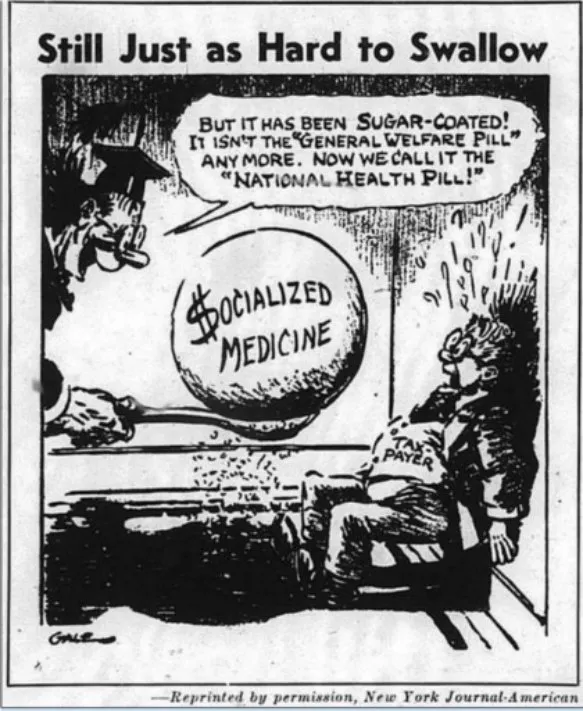
The AMA also targeted the bill’s funding approach, aligning with Republicans. Pamphlets, (Figure 4), exaggerated the impact on the taxpayer. Furthermore, statements such as those of Elmer Henderson, the AMA’s Chairman of the Board, who denounced the employer’s necessity “to contribute exorbitant payroll taxes” of up to 10%, or the AMA’s claim that “The cost of medical care…would be doubled and trebled by bureaucratic overhead,” convinced the middle class that Truman’s plan was more financially burdensome than helpful to healthcare. The economic argument was buttressed by the rapid expansion of the private insurance industry. Because the 1942 and ‘43 rulings by the War Labor Board and IRS respectively offered tax breaks to companies, such as US Steel and General Motors, who provided healthcare benefits, access to health insurance grew rapidly; employers could compensate lower wages by offering ‘fringe benefits’ to attract labor. In fact, in Mr. Henderson’s same speech, he spotlighted that out of 151 million people, “55,000,000 Americans are protected…[and] 37,000,000 policy holders are insured against surgical or medical bills.” All told, the AMA’s advertisement campaign was responsible for a 20% increase in private healthcare insurance enrollment, whereby in 1950, the number of Americans with employer-coverage grew to 142 million from 21 million in 1940. Conversely, approval for Truman’s plan plummeted to just 24% in 1950, convinced by how critics negatively portrayed the plan in respect to the status quo.
World War II’s end harbored a resurgence of Jim Crow segregation, a fear of communism, and a political, economic, and racial landscape that proved too hostile for Truman’s universal healthcare plan. Between the emergence of communism that caused a national panic, and the strong executive presence in national policy which threatened the pre-existing racial constructs, Truman proposed his universal healthcare proposal came at the worst possible time. Republicans, who disliked the taxes; Southern Democrats, who wanted to preserve segregation; and the AMA,which wished to enforce physician autonomy,utilized the “Red Scare” to their advantage, framing national healthcare as “socialized medicine,” decimating public support. Truman’s plan failed, and while it paved the way for Lyndon B. Johnson’s passing of Medicare and Medicaid in 1965, its failure established that the US would never have social services. So while President Johnson’s calling Truman “the real daddy of Medicare,” may have seemed flattering, it actually meant the death of the middle class’ healthcare hopes. From 1950 to 1970, consumer prices had increased 61% while medical costs soared by 125%, so for the socially disadvantaged, the implementation of Medicaid and Medicare came at the perfect time: three years after their enactment, more than 20 million individuals enrolled in the program, highlighting the bill’s scope. But given its target audience was the poor and the elderly, Medicare and Medicaid were passed because they were charity programs. LBJ viewed himself as a “bookend” to a decades-long struggle commenced by FDR and continued by Truman to improve public health, but in reality, Medicare and Medicaid symbolized the death of any future social services as any program needed to be unequivocally charitable. Aid to the middle class would have resulted in suspicions of socialist ideology, like those perceived to be found in Truman’s national healthcare proposal, and would terminate the plan immediately.
Appendix
Citations
- Alsan, Marcella, Yousra Neberai, and Xingyou Ye. Why the US doesn’t have national health insurance: The political role of the AMA. July 9, 2024. Accessed March 8, 2026. https://cepr.org/voxeu/columns/why-us-doesnt-have-national-health-insurance-political-role-ama.
- Bambra, C. Health Divides : Where You Live Can Kill You. Policy Press, 2023.
- Brown, Kreg Steven. “Progress in closing the U.S. racial wealth gap has stagnated, and even reversed course, in recent decades.” Chart. Washington Center for Equitable Growth, February 24, 2023. Accessed March 9, 2026. https://equitablegrowth.org/examining-the-history-of-the-u-s-racial-wealth-divide-shows-stagnating-progress-on-closing-these-disparities/#:~:text=In%20the%20decades%20following%2C%20 Black,1940%20that%20the%20paper%20examines.
- Burton, Kristen D. “Cold Conflict.” National WWII Museum. Last modified April 9, 2026. Accessed April 9, 2026. https://www.nationalww2museum.org/war/articles/cold-conflict#:~:text=Soviet%20efforts%20to%20claim%20territory,to%20restrict%20 Soviet%20global%20power.
- “The Challenge of National Healthcare.” National Archives Harry S. Truman Library - Museum. Accessed March 5, 2026. https://www.trumanlibrary.gov/education/presidential-inquiries/challenge-national-healthcare.
- Clark, Alexis. “Returning From War, Returning to Racism.” New York Times. Accessed July 30, 2020. https://www.nytimes.com/2020/07/30/magazine/black-soldiers-wwii-racism.html.
- Clemente, Michelle, Dr. “The founding of the NHS: 75 years on.” Gov UK. Last modified July 13, 2023. Accessed April 1, 2026. https://history.blog.gov.uk/2023/07/13/the-founding-of-the-nhs-75-years-on/.
- Cohen, Jack. “Cumulative fractional Nobel Prizes physics/chemistry/medicine.” Chart. Substantia, September 9, 2021. Accessed March 8, 2026. https://riviste.fupress.net/index.php/subs/article/view/1256#:~:text=The%20*Revolution%20in%20Science%20 in%20America%2C%201900%2D1950*,knowledge%20of%20atomic%20physics%20 to%20the%20US.
- Collier, Roger. “American Medical Association membership woes continue.” PMC. Last modified August 11, 2009. Accessed March 11, 2026. https://pmc.ncbi.nlm.nih.gov/articles/PMC3153537/#:~:text=In%20the%20early%201950s%2C%20about,now%20 belong%20to%20the%20AMA.
- “Cultural Diversity in Canada: The Social Construction of Racial Difference.” Government of Canada. Accessed April 1, 2026. https://www.justice.gc.ca/eng/rp-pr/csj-sjc/jsp-sjp/rp02_8-dr02_8/p2.html#:~:text=In%20contrast%2C%20those%20of%20British,distinct%20aboriginal%20rights%20and%20entitlements.
- “DEBATE GETS HOTTER OVER MIXED SCHOOLS.” Signers of Southern Pledge. U.S. News and World Report, March 23, 1956, 99-103. Accessed April 5, 2026. https://open.clemson.edu/cgi/viewcontent.cgi?article=2357&context=strom.
- Delmont, Matthew F. “January 31, 1942.” In Black Quotidian : Everyday History in African-American Newspapers, by Matthew F. Delmont. Stanford University Press, 2019. Accessed April 6, 2026. https://blackquotidian.supdigital.org/bq/january-31-1942.https://blackquotidian.supdigital.org/bq/january-31-1942
- Department of Commerce, Current Population Report Consumer Income, H.R. Rep. (Mar. 2, 1948). Accessed April 5, 2026. https://www2.census.gov/library/publications/1948/demographics/p60-02.pdf.
- DeWitt, Larry. “The Decision to Exclude Agricultural and Domestic Workers from the 1935 Social Security Act.” Social Security. USA. Last modified November 2010. Accessed April 8, 2026. https://www.ssa.gov/policy/docs/ssb/v70n4/v70n4p49.html#:~:text=Thus%20neither%20agricultural%20laborers%20nor,programs%2C%20even%20 the%20inferior%20ones.
- Dittmer, John. The Good Doctors : the Medical Committee for Human Rights and the Struggle for Social Justice in Health Care. Bloomsbury Press, 2009.
- DuBois, W.E.B. Introduction to An Appeal to the World. New York, 1947. Accessed April 14, 2026. https://www.crmvet.org/info/470000_naacp_appeal_un-r.pdf.
- “Executive Order 9981, Desegregating the Military.” National Park Service. Last modified August 21, 2023. Accessed April 10, 2026. https://www.nps.gov/articles/000/executive-order-9981.htm.
- Farmer’s Almanac Staff. “A Look Back At What Things Used to Cost.” Farmers’ Almanac. Last modified January 29, 2024. Accessed March 11, 2026. https://www.farmersalmanac.com/a-look-back-at-what-things-used-to-cost.
- Foner, Eric. The Story of American Freedom. W.W. Norton, 1998.
- “Former President Truman holds a copy of the famous Chicago Daily Tribune paper declaring “Dewey Defeats Truman” National Archives Harry S. Truman Library - Museum. Accessed April 16, 2026. https://www.trumanlibrary.gov/photograph-records/95-187.
- Guglielmo, Thomas A. “Desegregating blood: A civil rights struggle to remember.” PBS News. Last modified February 4, 2018. Accessed April 6, 2026. https://www.pbs.org/newshour/science/desegregating-blood-a-civil-rights-struggle-to-remember#:~:text=It%20was%20not%20until%201950,and%20Louisiana%20overturned%20similar%20 requirements.
- Harrison, Bobby. “The long history of white, Southern politicians rejecting health care expansion.” Mississippi Today. Accessed March 25, 2026. https://mississippitoday.org/2022/11/20/southern-politicians-medicaid-expansion/.
- Hayek, Friedrich A. von, William Warren Bartley, Peter G. Klein, et al. The Collected Works of F. A. Hayek. University of Chicago Press edition ed. University of Chicago Press, 1989. Digital file.
- Haynes, Douglas M. “Policing the Social Boundaries of the American Medical Association, 1847-70.” Journal of the History of Medicine and Allied Sciences 60, no. 2: 1-26.
- Herb, Joshua. “Health Policy in Action – A Brief History of Hospital Desegregation in the United States.” Association for Academic Surgery. Last modified February 27, 2025. Accessed April 1, 2026. https://www.aasurg.org/health-policy-in-action-a-brief-history-of-hospital-desegregation-in-the-united-states/.
- “Historical Population Change Data (1910-2020).” United States Census. Last modified April 2021. Accessed April 12, 2026. https://www.census.gov/data/tables/time-series/dec/popchange-data-text.html.
- “History of the US Health Care Industry.” EBSCOhost. https://www.ebsco.com/research-starters/consumer-health/history-us-health-care-industry.
- “The Holocaust.” The National WWII Museum New Orleans. Last modified May 8, 2024. Accessed April 5, 2026. https://www.nationalww2museum.org/war/articles/holocaust.
- Jacobs, Lawrence R., and Theda Skocpol. Health Care Reform and American Politics What Everyone Needs to Know, Revised and Updated Edition. 2nd ed. Oxford University Press, USA, 2014.
- Kevin McQueeney. A City without Care : 300 Years of Racism, Health Disparities, and Health Care Activism in New Orleans. Studies in Social Medicine. Chapel Hill: University of North Carolina Press, 2023. https://research.ebsco.com/linkprocessor/plink?id=e7d1d36b-7056-3a81-a558-bda8b17408a3.
- Knurick, Jessica. “We Were Never Meant to Have Universal Healthcare.” Dr. Jessica Knurick (blog), July 14, 2025. https://drjessicaknurick.substack.com/p/we-were-never-meant-to-have-universal.
- Konczal, Mike. “When Medicare Helped Kill Jim Crow.” The Nation, January 19, 2021, 1-27. Google Doc.
- Largent, Emily A. “Public Health, Racism, and the Lasting Impact of Hospital Segregation.” PubMed Center. Last modified September 17, 2018. Accessed April 1, 2026. https://pmc.ncbi.nlm.nih.gov/articles/PMC6225869/#bibr9-0033354918795891.
- Markel, Howard. “69 years ago, a president pitches his idea for national health care.” PBS News. Last modified November 19, 2014. Accessed March 8, 2026. https://www.pbs.org/newshour/health/november-19-1945-harry-truman-calls-national-health-insurance-program#:~:text=In%201945%2C%20President%20Harry%20S.%20Truman%20 proposed,medical%20care**%20*%20**Focusing%20on%20lost%20earnings**.
- McCarther, Shirley Marie. “A Black Who Wore White--a Look Back: Reflections of a Segregated Nursing Education Program at General Hospital No. 2 in Kansas City, Missouri.” American Educational History Journal 37, nos. 1-2 (2010): 291+. https://link.gale.com/apps/doc/A284325052/STOM?u=mlin_s_miltona&sid=bookmark-STOM&xid=2ddcc7bc.
- McCarther, Shirley Marie. “A Black Who Wore White--a Look Back: Reflections of a Segregated Nursing Education Program at General Hospital No. 2 in Kansas City, Missouri.” American Educational History Journal 37, nos. 1-2 (2010): 291+. https://link.gale.com/apps/doc/A284325052/STOM?u=mlin_s_miltona&sid=bookmark-STOM&xid=2ddcc7bc.
- McKay, Lisa Camner. “How the racial wealth gap has evolved—and why it persists.” Federal Reserve Bank of Minneapolis. Last modified October 3, 2022. Accessed March 9, 2026. https://www.minneapolisfed.org/article/2022/how-the-racial-wealth-gap-has-evolved-and-why-it-persists.
- “Medicare and Medicaid Act (1965).” National Archives. Last modified July 30, 1965. Accessed April 15, 2026. https://www.archives.gov/milestone-documents/medicare-and-medicaid-act.
- Miller, Thomas P. “Kill the Tax Exclusion for Health Insurance.” AEI. Last modified August 19, 2014. Accessed April 6, 2026. https://www.aei.org/articles/kill-the-tax-exclusion-for-health-insurance/#:~:text=The%20simplified%20history%20of%20the,sponsor%20group%20health%2Dinsurance%20plans.
- Moris, John D. “Truman’s Health Plan Compared With British.” New York Times, May 1, 1949, E7, 131. PDF.
- Morrisey, Michael A. Health Insurance. 2nd ed. Health Administration Press ; Association of University Programs in Health Administration, 2014. Digital file.
- New York Times. “AMA Statement on Truman Health Plan.” April 25, 1949, 8. PDF.
- New York Times. “Senate Panel Defied by Kentucky Couple on Subpoenaed Files.” March 5, 1969, sec. L, 10. Accessed April 5, 2026. https://www.nytimes.com/1969/03/05/archives/senate-panel-defied-by-kentucky-couple-on-subpoenaed-files.html#:~:text=WASHINGTON%2C%20March%204%E2%80%94%20The%20Senate,subcommittee%20members%20and%20staff%20aides.
- O’Connell, Patricia. “World War II and ‘The Golden Age of Capitalism.’” This Is Capitalism. Accessed April 8, 2026. https://www.thisiscapitalism.org/blog/world-war-ii-and-the-golden-age-of-capitalism#:~:text=Numerous%20industries%20 thrived%20because%20of,possible%20by%20the%20GI%20bill.
- Owen, David. Ethnic Minorities in Great Britain : Settlement Patterns. Centre for Research in Ethnic Relations, 1992.
- Palmer, Karen S. “A Brief History: Universal Health Care Efforts in the US.” Physicians for a National Health Program. Last modified 1999. Accessed March 9, 2026. https://pnhp.org/a-brief-history-universal-health-care-efforts-in-the-us/.
- Pentecost, Michael J. “The Future of Employer-Based Health Insurance.” In PubMed. Last modified 2007. https://pmc.ncbi.nlm.nih.gov/articles/PMC3057748/#:~:text=Between%201940%20and%201950%2C%20the,21%20million%20to%20142%20 million.&text=In%201954%2C%20the%20pre%2Deminence,tax%20deductibility%20 of%20such%20premiums.&text=A%20tax%20break%2C%20a%20popular,59%25%20 (Figure%202).
- Pilgrim, David. “What Was Jim Crow.” Jim Crow Museum. Ferris State University. Last modified 2024. Accessed March 6, 2026. https://jimcrowmuseum.ferris.edu/what.htm#:~:text=Jim%20Crow%20was%20the%20name,was%20a%20way%20of%20life.
- Roosevelt, Franklin Delano. “State of the Union Address.” Speech presented in Washington DC, Washington DC, January 6, 1941. https://www.archives.gov/milestone-documents/president-franklin-roosevelts-annual-message-to-congress.
- Rosenberg, Charles E. The Care of Strangers : the Rise of America’s Hospital System. Basic Books, 1987.
- Saad, Lydia. “Gallup Vault: A Flip-Flop on National Health Insurance.” Gallup. Accessed May 17, 2016. https://news.gallup.com/vault/191582/gallup-vault-flip-flop-national-health-insurance.aspx#:~:text=In%20November%201945%2C%20President%20Harry,federal%20aid%20to%20the%20states.
- Schram, Sanford, Joe Soss, and Richard C. Fording. Race and the Politics of Welfare Reform Edited by Sanford F. Schram, Joe Soss, and Richard C. Fording. University of Michigan Press, 2003.
- Social Security Act, 1 Stat. (Aug. 14, 1935). Accessed April 9, 2026. https://www.ssa.gov/history/35act.html.
- Thomas, Karen Kruse. “The Hill-Burton Act and Civil Rights: Expanding Hospital Care for Black Southerners, 1939-1960.” The Journal of Southern History 72, no. 4 (2006): 823-70. https://doi.org/10.2307/27649234.
- Truman, Harry S. “Truman Doctrine.” Speech presented at Congress, Washington DC, Washington DC, March 12, 1947. National Archives. Last modified March 12, 1947. Accessed April 5, 2026. https://www.archives.gov/milestone-documents/truman-doctrine.
- “Unit 13 Immediate Postwar Years, 1945-1953.” NJ State Library. Accessed March 6, 2026. https://www.njstatelib.org/research_library/new_jersey_resources/highlights/african_american_history_curriculum/unit_13_postwar_years/.
- “Who started Canada’s universal health care system?” Canadian Medical Association. Accessed April 1, 2026. https://www.cma.ca/healthcare-for-real/who-started-canadas-universal-health-care-system.
- Yarrow, Andrew L. “Harry Truman’s Radical Health Care Plan.” Milken Institute Review. Last modified February 18, 2021. Accessed April 11, 2026. https://www.milkenreview.org/articles/harry-trumans-radical-health-care-plan#:~:text=Gallup%20found%20 that%2059%20percent,threshold%20%E2%80%94%20much%20like%20Social%20Security.