History
Bleeding Hearts and Bylines: How Female War Correspondents Redefined War, Gender, and Journalism in World War II
Summary
Draft summaryThis paper follows three American war correspondents of World War II, Martha Gellhorn, Lee Miller and Sigrid Schultz, who worked in a profession that sought to exclude women. It argues that by leveraging, rejecting and redefining gender-based stereotypes they reshaped war journalism around the suffering of individuals rather than battlefield triumph.
Contents
These women were feisty, whiskey-drinking, and brave.
As gunfire erupted across Europe in early September of 1939, World War II swiftly plunged the world into havoc. This severity heightened attention to war journalism as over 1,600 American correspondents swarmed to European and Pacific battlefronts to chronicle the war for millions of Americans at home. War correspondence was seen as an “unladylike” profession, however, excluding women as they were deemed unfit for undergoing the cruel reality of combat, destruction, and survival. Women in the field of war correspondence were given limited access to the front lines, having to fight hard to earn a place. Yet some women refused to give in to these constraints. Despite the systemic barriers imposed upon them, a select group of female war correspondents prevailed and transformed exclusion into opportunities. Through Martha Gellhorn, Lee Miller, and Sigrid Schultz— three pioneers in their fields—American female war correspondents during World War II navigated an exclusive profession by leveraging, rejecting, and redefining gender-based stereotypes. By focusing on the struggles of individuals in war, cultivating courage through war trauma and identity crises, and asserting authority in male-dominated spaces, these individuals transformed restrictive expectations placed on women into an overlooked form of feminine expression, thereby reshaping war journalism to foreground a more intimate and expansive narrative of World War II.
Gendered Constraints and the Emergence of Female Agency in War Correspondence
By the turn of the twentieth century, women were entering the field of journalism at increasing rates. As historians summarized based on the Census, the number of female reporters and editors increased by a striking 2,158 in the thirty years from 1870 to 1900. Still, this numerical growth did not translate to widespread acceptance of female journalists in professional and social contexts. More broadly, this marginalization extended beyond war correspondence: journalism and intellectual activities were already viewed as unsuitable for women, in contrast to their domestic roles. American housewives, for instance, were barred from scholarly pursuits as they were occupied with household labor. As Norma Yerger, a Utah housewife, reported amid World War II, after finishing all the chores up to expectation, she would always be “too weary to read any professional social work literature” while her husband retained the leisure to pursue intellectual activities. Even within the field of journalism, however, female reporters were nevertheless circumscribed. In the 1900s, female journalists were largely confined to reporting “soft news,” or news pertinent to fashion, society, and other traditionally feminine domains.
It was in the midst of such systematic constraints that some of the most ambitious and resilient women in the field of war correspondence rose to the occasion. Martha Gellhorn, a prominent American war correspondent, gained recognition for her frontline reporting on D-Day, persistently defying restrictions placed on women in the face of the brutality of war. Lee Miller, a model-turned-photojournalist, documented the cruel aftermath of war from evacuation hospitals to concentration camps, deploying a uniquely human and intimate lens that reshaped the narrative of war. Sigrid Schultz, the Berlin bureau chief of the Chicago Tribune, underwent continuous surveillance and threats from German officials, navigating both gender biases and identity crises while maintaining her authority. Through their work, these female correspondents not only secured a place in a profession that sought to exclude them but also did so by leveraging restrictive expectations, forging resilience in the face of trauma, and navigating authority in male-dominated spaces.
Leveraging Gender Constraints to Reframe War Narratives
When faced with stereotypes prohibiting them from entering particular fields regulated for male reporters, female war correspondents like Martha and Lee spent countless hours working in medical fields to focus on the perspective of war casualties, delineating a humanitarian perspective of war by leaning into such gender-biased constraints. Of the many accounts of major battles like D-Day, one conspicuous narration was that of Martha’s. In the midst of Martha and her former husband Ernest Hemingway’s scuffle, he had gotten a ticket on an assault craft to observe D-Day in person. Unwilling to miss the opportunity, Martha secured a berth on a Norwegian freighter carrying military equipment to Liverpool. Even so, she nearly missed the Allied invasion of Occupied France on July 6, 1944, when guards at the ship refused to grant her access due to her female identity. Martha then stepped onto a hospital ship, forged the excuse of an interview with the nurses onboard, and stowed away in a bathroom stall for their journey across the English Channel. During the journey, as the ship became swamped by flocks of wounded soldiers, she posited:
Piles of bloody clothing had been cut off and dumped out of the way in corners; coffee cups and cigarette stubs littered the decks; plasma bottles hung from cords, made shadows on the walls. There were wounded who groaned in their sleep or called out and there was the soft steady hum of conversation among the wounded who could not sleep.
In doing so, Martha had shrewdly transformed her gender identity from a barrier into a privilege; rather than reporting on the conventional grandiosity of the warfare, she shifted her reporting to a more individualized perspective. Not only did she note down the visual catastrophe of the environment in front of her, but she also observed that the wounded soldiers “talked among themselves[,] and as time went on[,] we got to know them, by their faces and their wounds, not their names.” Martha’s observations underscored that, in the face of war, individuality was too often lost—if not for her identity as a woman, the stories of the wounded might have been lost to sight over time.
Meanwhile, Hemingway’s account of D-Day, titled Voyage to Victory, focused heavily on his interactions with the American soldiers and coxswain, underscoring an apparent sense of pageantry as if the battlefield were a pomp of war. Concluding the article with “we had taken the beach,” Hemingway’s account of D-Day ultimately emphasized the triumph of the operation rather than the sufferings it entailed. In comparison, Martha portrayed, “Men smiled who were in such pain that all they can really have wanted to do was turn their faces away and cry, and men made jokes when they needed their strength just to survive.” In embracing the gender-based restrictions she faced at D-Day, Martha focused on the anonymous suffering of the individuals in war, rather than upholding a heroic victory, and reframed the narrative of war not as a stage for valor but as a cruel reality where human fragility was uncovered.
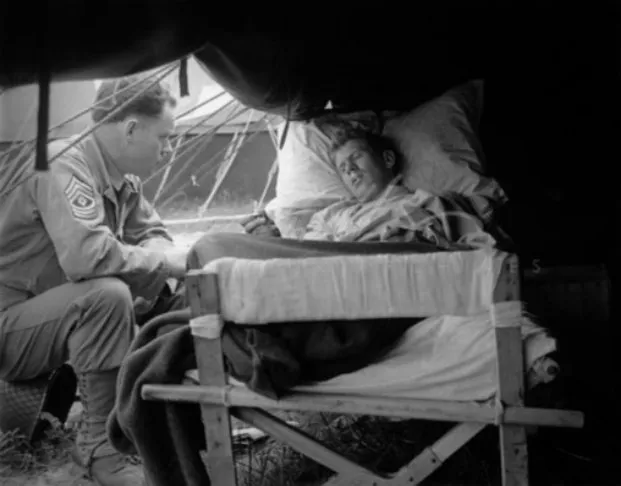
Similarly, Lee’s efforts at the 44th Evacuation Hospital also demonstrated the essence of the unseen suffering in World War II through her feminine journalistic expression. A month and a half after the D-Day landings in June 1944, Lee was assigned to interview and write a short photographic essay about the U.S. army nurses at the 44th Evacuation Hospital in Normandy, France. Rather than sticking to the assignment, however, Miller photographed sick patients, war casualties, skilled doctors, and nurses at the tents for five days, crafting an in-depth multipiece on the hospital. Case in point, Lee photographed Smoke or chat to see if he’s real, 44th Evacuation Hospital (see Figure 1). As captured, a patient at the hospital lies on his bed, his face revealing agony. Another soldier sits beside him, looking at him with care and sympathy. Miller specifically titled this work “Smoke or chat to see if he’s real,” highlighting that, though the soldiers represented a larger nation at war, they were also humans with real losses and emotions. In capturing this true, vulnerable interaction between these two soldiers, Lee reframed them not as distant subjects of warfare but as emotionally complex individuals, often misrepresented in other accounts of war correspondence.
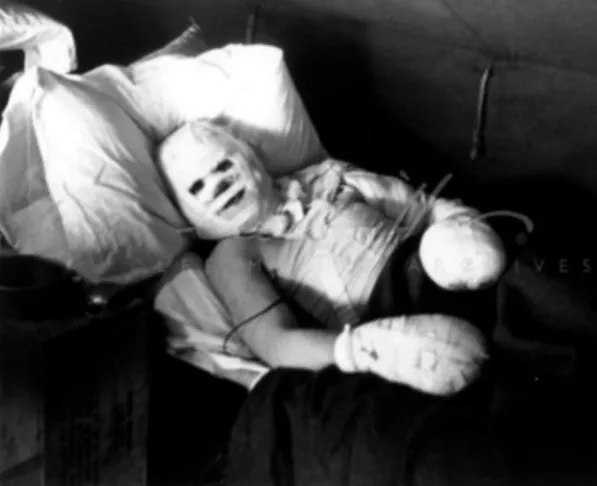
Moreover, Lee’s Bad burns case at 44th Evacuation Hospital (see Figure 2) further indicated her particular intent to signify the neglected sufferings of casualties in the war. As shown in the picture, a bad burns patient lies on a bed, looking at the camera. The bandages on his body are fully visible, showing the degree to which the war can impair an individual. Miller captioned, “A bad burn case asked me to take his picture, as he wanted to see how funny he looked. It was pretty grim, and I didn’t focus well.” As is evident in the photograph, the “grim” imagery of the patient’s extensive injuries and hollow eyes reflects the bleak reality and cruelty of war. Surprisingly, rather than being punished for her disobedience and straying off task, Miller’s work was so moving that it was published in full, with 14 accompanying pictures, under the title “Unarmed warriors.” Though it was reduced to four pages in American Vogue, it was still widely circulated, especially among people working in field hospitals, as their jobs often went overlooked. Ultimately, the work of female war correspondents like Martha and Lee at hospitals—focused not on the monumental moments of war but on the anonymous sacrifices and misery of wounded soldiers—tactfully leaned into the gender-based restrictions that barred them from the front lines to craft sympathetic pieces that represented the often-neglected facet of World War II.
Redefining Courage: Reshaping Trauma into Resilience
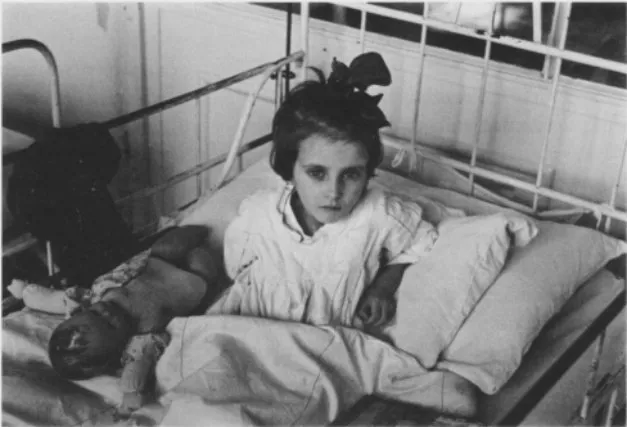
Beyond leveraging certain gender-based restrictions, female war correspondents like Lee and Sigrid also constantly confronted war trauma and identity crises to reject gender-biased stereotypes that suggested the violence of war was exclusively fit for masculinity, embodying the grace of courage in their pieces and work ethic. Sexually assaulted by a family friend at the age of seven and constantly taken nude pictures by her father, an amateur photographer, Lee developed a complex relationship with vulnerability and control that deeply informed her artistic lens. Consequently, rather than portraying the subjects of her photos as part of heroic imagery, Lee’s photographs often centered on moments of softness and intimacy, such as establishing a contrast between a child or a civilian and the brutal surroundings. As shown in her Young Girl in Hospital Bed (see Figure 3), taken at the Vienna University Children’s Hospital, a young girl lies confined with stark white railings, visually evoking both protection and entrapment. The photograph grows more disturbing upon noticing a ragged doll lying in the shadows to the left. The juxtaposition between a frayed doll and the vulnerable female subject who underwent the reality of fascism resembled Nazi Germany’s brutal dehumanization. Through her deliberate focus on seemingly minor yet symbolic details, Lee challenges the conventions of photojournalism, compelling readers to confront the daunting costs of war. While the prevailing notion held that women lacked the fortitude to be war correspondents, Lee, by contrast, demonstrated that her sensitivity testified to her resilience and recovery from previous traumatic experiences, defying these stereotypes by practicing a deeper, more penetrating form of war journalism.
In the same vein, driven by her will to reveal the atrocities of concentration camps, Lee’s reports on Dachau and Buchenwald established that resilience in war was not solely confined to physical combat but also defined by the willingness to witness and endure trauma. Days after U.S. troops liberated the Buchenwald concentration camp on April 11, 1945, Lee and Margaret Bourke-White arrived to document the aftermath of the camp. Upon entering, they found nearly 21,000 emaciated and near-death prisoners along with a block for medical experiments, a site for torture and execution, and a crematorium. Though the cleaning process had already begun and the initial shock of horror had largely subsided, Lee and Margaret still reported on the depravity they observed. In her Freed Prisoners Scavenging the Rubbish Dump (see Figure 4), the aftermath of liberation was stripped of any triumph in Lee’s portrayal. In the photograph, prisoners wander drably in the rubbish dumps; their ghostly figures reveal how deeply dehumanization had permeated in Buchenwald, constituting the orthodox narrative of a triumphant liberation with a cruel reality documenting the lingering physical and psychological consequences of fascism. Furthermore, two weeks after her visit to Buchenwald, Lee arrived at the Dachau concentration camp with Dave Scherman promptly after its liberation. In comparison to Buchenwald’s muted atrocities, Lee exclaimed, “Dachau had everything you’ll ever hear or close your ears to.” In the appalling remains of the concentration camp, Lee noted that she saw “the bestial death of the hundreds of starved and maimed men and women,” demonstrating not only the horrid scale of suffering but also her refusal to step back from the cruel reality. Lee’s unwavering endurance revealed that, rather than lacking the resolve to excel in their roles of war correspondents, women bore the willingness to confront, endure, and expose the war’s harrowing realities. In doing so, she redefined the boundaries of courage in war journalism, transforming the narrative of battlefield heroism to foreground the human cost of war.
On the other hand, operating with Nazi Germany, Sigrid confronted not only the inherent dangers of war correspondence but also a system of constant surveillance and targeted intimidation that threatened her identity as a Jewish woman. As the Nazi regime gradually consolidated power, Sigrid found herself constantly under latent scrutiny: her telephone calls were tapped, her mail was monitored, and even her household was under surveillance. These threats did not escalate until June 11, 1933, when Sigrid received her first summons to their headquarters from the Gestapo. Upon notice of her visit, the American embassy offered to accompany her, but Sigrid then responded in a letter that she “did not feel fidgety about anything” and was willing to “face the lions” alone. Sigrid remained resolute in the process, even if the officials made it clear that the truth was no armor against punishment. As Sigrid declared in the letter, “Some official thought a little summons to G.S.P. might prove intimidating, which was an extremely foolish thought. I have always made it a point to stick to facts as closely as humanly possible and I don’t see how anybody in his senses could object to factual reporting.” Her persistence under such conditions contradicted the notion that women lacked resilience to pursue war correspondence, demonstrating that courage was not limited to physical proximity to war but extended to the psychological endurance of political pressure.
Rather than backing down from the pressure in the ensuing years, Sigrid persevered with her exposé articles on the Nazi’s anti-Jewish legislation, political violence, and the erosion of civil liberties. In her 1938 article, Hitler Seizes 20,000 Jews, she underscored the “systematic destruction of Jewish property, looting, arson, and wholesale arrests of Jews without official charges,” while contrasting how the police “walked unconcernedly through the havoc-bent crowds as if everybody was out for an enjoyable afternoon stroll.” In documenting both the violence inflicted upon citizens and the state’s indifference, Sigrid exhibited her courage by not shying away from reporting brutal truths, knowing the risks of retaliation from authorities. Moreover, when Gestapo agents attempted to incriminate her by planting false evidence in her household, she directly opposed the Nazi military commander Hermann Göring, publicly accusing him of orchestrating the scheme. Rather than retreating from intimidation and surveillance from the Nazi authorities, Sigrid chose to define her courage through establishing her credibility as a fair and factual reporter, earning herself the name of “the dragon from Chicago” from Göring, one of the most powerful figures in Nazi Germany. As such, Lee and Sigrid’s work ethic ultimately reveals that the courage required to be a female war correspondent was not solely defined by physical presence on the battlefield, but by the willingness to confront systems of power and reshape how truth could be documented.
Navigating Their Voices in Male-Dominated Spaces
Not only did they have to confront the inherent identity hardships, but the interactions between female war correspondents like Sigrid and Martha and male figures, both in professional and personal spaces, further revealed the constant need to navigate a path between cooperating with colleagues and confidants and rejecting relationships that caged them in traditional roles. As the Berlin office bureau chief of the Chicago Tribune, Sigrid operated within a male-dominated newsroom, often having to assert her professional credibility while resisting gender-biased notions that confined her to a more limited journalistic role. While most female journalists in the 1900s were expected to report “soft news,” many were dismissed as “sob sisters,” female journalists who were expected to report sentimental crimes. On the other hand, Sigrid deliberately rejected these stringent labels, namely the titles of “girl reporter” or even “newspaperwoman,” preferring to be called a “newspaperman.” Such a linguistic choice revealed not only Sigrid’s personal preference but also her acknowledgment of the gendered hierarchy associated with journalism, strategically aligning herself with male expectations to gain credibility.
In her workspace, Sigrid constantly confronted microaggressions due to her gender identity, so much so that she became accustomed to regarding them as humorous anecdotes. As one contemporary recalled, Sigrid remarked that she was often “the only woman correspondent… among all the big-shot males who looked upon [her] as a freak, if not a threat.” Under such conditions, Sigrid could not rely solely on her hopes and ambition to achieve her career goals but had to carefully calibrate her attitude without losing her sense of authority. In one instance, early in her tenure as bureau chief, Sigrid was denied entry to a banquet of economic leaders on the grounds that women were not allowed. Sigrid’s calculated wit became evident when, rather than bluntly confronting the situation, she decided to send in a note that read, “Are two hundred men scared of one woman?” Ultimately, the press leader stepped outside the room, laughing, and escorted Sigrid into the event. “One big boss after the other came over to interview the strange woman,” Sigrid reflected after the incident, “and from then on I never had any trouble seeing world leaders.” By astutely resolving the conflict with humor, Sigrid demonstrated that her success in a male-dominated space was not a simple task but was achieved through a careful strategy that balanced respect for colleagues with a refusal to accept gender barriers.
Furthermore, while many women were expected to define themselves through relationships with men, Martha focused on establishing independence and prioritizing ambitions in her personal relationships, resisting roles that limited her career. In her letters, Martha unveiled her unwillingness to marry and share her daily life with a partner, considering marriage the “original anti-aphrodisiac.” This reluctance in a stable relationship was further demonstrated through the tensions in her relationship with Hemingway. In Hemingway’s play The Fifth Column, the character Dorothy Bridges, a blonde, American war correspondent, was modeled almost exactly after Martha. Consequently, Hemingway discovered an outlet for unleashing his discontent, outright describing Dorothy as a “bored Vassar bitch... [who] has had affairs, abortions, ambitions.” Indeed, Hemingway’s stark comments on her were somewhat true, for Martha’s affairs, abortions, and ambitions remained her top priorities as she slowly realized Hemingway’s expectations of dominance clashed sharply with her insistence on independence. Reflecting on his attitude towards her, Martha noted in her letters, “He was never kind to me... because I was the woman he wanted, which means the woman he intended absolutely to own, crush, eat alive.” In rejecting the emotional and social expectations placed upon her due to her gender identity, Martha’s relationship with men indicated that navigating a male-dominated world not only required professional resilience, but also the ability to resist personal relationships that imposed restrictive gender roles. Ultimately, through the experiences of Sigrid and Martha with male acquaintances, female war correspondents displayed that success in a male-dominated field required not only professional competence but also negotiation, resistance, and the redefinition of the orthodox expectations placed upon them.
Who Tells the War, Defines the War
In the course of World War II, female war correspondents were often pushed to the margins of gender-based exclusion. Women were denied access to a first-hand experience to witness gunfire, thought to lack the resilience to endure the hardship of war journalism, and were immured in traditional roles that sought to constrain their ambitions, as reflected in Hemingway’s remark to Martha, “Are you a war correspondent or wife in my bed?” These constraints, however, failed to limit the scope of their work. Instead, female correspondents harnessed the limitations in professional spaces and chronicled the sentimental suffering of war casualties. They rejected stereotypical notions and demonstrated their resilience through overcoming traumatic experiences targeting their identities. In their interactions with men in their workspaces and personal lives, female correspondents navigated their surroundings by prioritizing their authority and ambitions, rejecting traditional roles that reinforced gender-based stereotypes and threatened their careers. Yet, their impact extends beyond the context of World War II. In foregrounding the struggles of individuality, these women laid the groundwork for modern-day journalism’s emphasis on humanitarian focus and human-centered storytelling. Ultimately, these female war correspondents did not merely overcome exclusion but helped reshape the boundaries of journalism, transforming its usual narrative of a majestic triumph to the intimate realities of war sufferings and societal pressures. These women did not merely bear witness to the war; they redefined what it meant to witness it.
Appendix
[The printed issue gives this caption on page 96 but the photograph itself is missing.]
Citations
- Burke, Carolyn. Lee Miller: On Both Sides of the Camera. London: Bloomsbury, 2006.
- Gellhorn, Martha. “The First Hospital Ship.” In The Face of War. London: Virago, 1986.
- Gellhorn, Martha. Selected letters of Martha Gellhorn. Compiled by Caroline Moorehead. New York: Henry Holt and Company, 2006. https://archive.org/details/selectedletterso00gell/page/158/mode/2up.
- Gregor Ziemer, “Sigrid Schultz,” in LGJ Pays Tribute to the Literary Women of the Twenties, Lost Generation Journal IV, no. 1 (Winter 1976): 3.
- Haider, Arwa. “’Lee Miller was the bravest person I ever knew’: The pioneering photographer who captured the horror of World War Two.” BBC, October 7, 2025. Accessed April 4, 2026. https://www.bbc.com/culture/article/20251006-lee-miller-the-most-fearless-photographs-of-the-20th-century.
- Hemingway, Ernest, quoted in Foster, Alyson. “Married to Her Writing.” National Endowment for the Humanities. Last modified 2023. Accessed April 16, 2026. https://www.neh.gov/article/married-her-writing.
- Hemingway, Ernest. “Voyage to Victory.” Collier’s, July 22, 1944, 11-13, 56-57.
- Hemingway, Ernest. The Fifth Column and Four Unpublished Stories. New York: Charles Scribner’s Sons, 1970. https://archive.org/details/fifthcolumnfours00hemi/page/n5/mode/2up.
- Jackson-Schebetta, Lisa. “Between the Language and Silence of War: Martha Gellhorn and the Female Characters of Hemingway’s The Fifth Column.” University of Toronto Press 53, no. 1 (2010). Accessed April 16, 2026. https://utppublishing.com/doi/10.3138/md.53.1.057#:~:text=WORKS%20CITED-,ABSTRACT,the%20rhetoric%20of%20war%20depends.
- Jeffrey Meyers. “Lee Miller and Martha Gellhorn: Parallel Lives.” The Antioch Review 73, no. 1 (2015): 56-64. https://doi.org/10.7723/antiochreview.73.1.0056.
- Jennifer Putnam, PhD. “Lee Miller: Witness to the Concentration Camps and the Fall of the Third Reich” Published March 28, 2024. Accessed April 8, 2026. https://www.nationalww2museum.org/war/articles/lee-miller-witness-concentration-camps-and-fall-third-reich.
- Jewish Social Studies 7, no. 1 (1945). http://www.jstor.org/stable/4464652.
- Lamb, Christina. “THE CORRESPONDENTS: Six Women Writers on the Front Lines of World War II, by Judith Mackrell.” New York Times, November 21, 2021. Accessed April 2, 2026. https://www.nytimes.com/2021/11/02/books/review/the-correspondents-judith-mackrell.html.
- Mackrell, Judith. The Correspondents : Six Women Writers on the Front Lines of World War II. Doubleday, 2021.
- Maggie Hartley, EdD. “Martha Gellhorn: Eyewitness to War” Published March 9, 2022. Accessed April 13, 2026. https://www.nationalww2museum.org/war/articles/martha-gellhorn-eyewitness-war.
- Miller, Lee. Bad burns case at 44th Evacuation Hospital. 1944. Photograph. Accessed April 1, 2026. https://images.leemiller.co.uk/media/-A-bad-burns-case-asked-me-to-take-his-picture-as-he-wanted-to-see-how-funny-he-looked-It-was-pretty-grim-and-I-didn-t/1NKTEd_6Klg_PI9RHCrXjw..a?ts=GgSMHMv7Jr9QGc8BFpHR8w..a.
- Miller, Lee. Freed prisoners scavenging in the rubbish dump. 1945. Photograph. https://images.leemiller.co.uk/media/Lee-Miller-wrote-Prisoners-were-prowling-these-heaps-some-of-which-were-burning-in-the-hope-of-finding-something-more/ia1Ns6AIfdl92Qvwoj1ryA..a?ts=Cq_T3Pnn1BWh5tXw0Zl3xTkJiqC5cfZf1-y91vlGitc.a.
- Miller, Lee. Smoke or chat to see if he’s real, 44th Evacuation Hospital. 1944. Photograph. Accessed April 1, 2026. https://images.leemiller.co.uk/media/_52s3RgyUy6xUVTW91PcoQ..a?ts=O_ij-45aKgvIl0GefJfyAYTkh-DQ7CtuWu2lw6hf-jo.a.
- Miller, Lee. Young girl in hospital bed. 1945. Photograph. https://images.leemiller.co.uk/media/yY8ZI2WYUsVasxeVSj6ZAg..a?ts=Hbr79uNm_PsHQWiitujZlA..a.
- “Miller, Lee.” In Chambers Biographical Dictionary, 9th ed., edited by Liam Rodger and Joan Bakewell. London, UK: Chambers Harrap, 2011. https://search.credoreference.com/articles/Qm9va0FydGljbGU6MTIyNTkyMg==?aid=148630.
- Moorehead, Caroline. Gellhorn: A Twentieth Century Life. New York: Henry Holt and Co., 2003.
- Moorehead, Caroline, comp. Selected Letters of Martha Gellhorn. New York: Henry Holt and Co., 2006.
- Mort, Terry. Hemingway at War : Ernest Hemingway’s Adventures as a World War II Correspondent. New York: Pegasus Books, 2016.
- Moynihan, Sandi. “Reporting From the Front Lines of WWII.” United Service Organizations. Last modified November 24, 2015. Accessed April 11, 2026. https://www.uso.org/stories/123-reporting-from-the-front-lines-of-wwii#:~:text=Over%201%2C600%20 war%20correspondents%20flocked,reporter%20in%20Europe%20in%201939.
- Rollyson, Carl, George Anderson, P., Judith Baughman, S., and Matthew Bruccoli, J. “Gellhorn, Martha.” In Encyclopedia of American Literature, 3rd ed., edited by Inc Manly. New York, NY, USA: Facts On File, 2013. https://search.credoreference.com/articles/Qm9va0FydGljbGU6MTI0MzU4OQ==?aid=148630.
- Salvio, Paula M. “Uncanny Exposures: A Study of the Wartime Photojournalism of Lee Miller.” Curriculum Inquiry 39, no. 4 (2009): 521-36. http://www.jstor.org/stable/20616447.
- Schultz, Sigrid, quoted in Julia Edwards, Women of the World: The Great Foreign Correspondents (Boston: Houghton Mifflin, 1988).
- Schultz, Sigrid. “Hitler Seizes 20,000 Jews.” In Part One: American Journalism 1938-1944, by Gertrude Stein. Vol. 1 of Reporting World War II. Literary Classics of the United States : Distributed by Penguin Books, 1995. Previously published in Chicago Tribune, November 10, 1938.
- Sorel, Nancy Caldwell. The Women Who Wrote the War. Arcade : Time Warner Trade [distributor], 1999.
- Toler, Pamela D. The Dragon from Chicago: The Untold Story of an American Reporter in Nazi Germany. Boston: Beacon Press. pdf.
- Yerger, Norma E. “Mrs. Norma Yerger Queen Reports on the Problems of Employed Mothers in Utah.” 1944. In Major Problems in American Women’s History : Documents and Essays, by Sharon Block, Mary Beth Norton, and Ruth M. Alexander. 5th ed. Cengage Learning, 2014.