History
The Division Within the Chilean Catholic Church During Augusto Pinochet’s Regime from 1973 to 1988
Summary
Draft summaryThis paper examines the division within the Chilean Catholic Church under Augusto Pinochet, contrasting Cardinal Raul Silva Henriquez’s open confrontation of the regime from 1973 to 1983 with the conciliatory approach of Cardinal Juan Francisco Fresno and Pope John Paul II from 1983 to 1988. It argues that both approaches contributed to the success of the “vote no” movement in the plebiscite that ended the dictatorship.
Established in 1956, the Chilean Roman Catholic Church shared common goals with the Chilean central government for decades. Both institutions supported stability, order, and social harmony and opposed radical political movements, common interests which made them natural allies with each other. However, this relationship between the church and state shifted in 1973, when General Augusto Pinochet staged a coup d’état on previous Chilean president Salvador Allende and established a military junta. As Pinochet’s dictatorship and the junta’s human rights abuses continued, the church took a more distinct role in the political and social state of the people of Chile. During this time, the major leaders of the Catholic Church in Chile were Cardinal Archbishop Raul Silva Henriquez in the first ten years and Juan Francisco Fresno during the last five years, both serving under Pope John Paul II, the head of all Catholic Churches worldwide. Many individuals within the layers of the Catholic Church hierarchy formed vastly different attitudes towards the regime: while some held mediatory roles and condoned the junta, many found themselves in full-blown opposition against Pinochet. The coexistence of the non-confrontational attitudes toward Pinochet of both the Pope and Cardinal Fresno from 1983 to 1988 versus the highly assertive and confrontational approach of Cardinal Silva from 1973 to 1983 fueled the central divide between mediation versus the confrontational attitudes in the Chilean Catholic Church.
For the first ten years of the regime, from 1973 to 1983, despite the conflicting voices of the conservatives within the catholic church, Cardinal Silva, an exception to the other leaders of the Chilean Church, publicly denounced Pinochet and actively opposed the regime. The cardinal directly served both the Pope and the Archbishop of Santiago, the most important Catholic leader in Chile. In contrast with both the Pope and the later Cardinal Fresno, Cardinal Silva used his power to publicly oppose Pinochet’s junta right from the beginning by issuing public statements at the start of the regime in 1973 and 1974. On September 11th, 1973, just thirteen days after the coup, obvious human rights violations had already begun. Visible mass detentions appeared in the National Stadium of Santiago and hundreds of detainees were requesting help from the Church and the Catholic priests. When Cardinal Silva visited the stadium, he recalled that he was “unable to hold back his tears” due to the unbearable conditions there. Then, in his first public announcement actively supporting human rights, he said to the prisoners in the large speakers, “I am the representative of a Church that is the servant of everyone, especially of those that are suffering. I want to serve you and like the Lord, I do not ask who you are or what are your beliefs or political positions. I put myself at the disposal of the detainees.” His words revealed that he will take an active role in ensuring human rights, while the fact that he is making his pro-peace and anti-junta stance clear just thirteen days after the coup–before the Chilean church figured out how to establish ties with the junta–suggests his strong desire to resist Pinochet and the horrific crimes the government committed towards the Chilean people. In addition, on April 24th of 1974, after seven months of even more tortures, disappearances, and mass detentions, Cardinal Silva issued “a declaration accusing the military junta of the use of torture, arbitrary and lengthy detentions, of making job dismissals for political reasons,” calling for “such situations” to “be overcome only by the unrestricted respect for human rights as formulated by the United Nations and the Second Vatican Council.” This document, supported by most bishops in Chile, directly accused the Chilean junta in extremely overt language of the human rights violation they have committed, demonstrating Silva’s use of his power in the Church to oppose the government’s actions. However, not all bishops and archbishops in Chile fully supported the cardinal’s decision to overtly acknowledge that the junta had committed human rights violations. On May 20th, 1974, just 24 days after Silva’s document was distributed, an originally classified telegram from the CIA notes that Valparaiso’s Archbishop Luis Antonio Tagle had issued a “pro-junta” and “anti-marxist” statement himself, while archbishop of La Serena, Juan Francisco Fresno also issued a statement supporting government policies such as “granting land to peasants [and] farming workers’ cooperatives”. Both statements by the conservative archbishops “completely ignore[d] the issue of human rights violations which originally prompted” the April 24th declaration by the Cardinal. The fast 24-day response of both Tagle and Fresno reveals the hidden dissent within the Chilean Church. Yet, these conflicting voices were overpowered by Cardinal Silva’s active opposition towards the regime after the first half of 1974.
During this time, Cardinal Silva was also a strong advocate for the rights of Chileans through his action with the organization Pro Paz and the founding of the Vicaria de Solidaridad (Vicariate of Solidarity) under the church. The Comite de Cooperacion Para La Paz (Pro Paz) was founded in 1973 by the various Churches across Chile and headed by Cardinal Silva. Originally, the Churches believed it was a temporary response to the changing government that wouldn’t last past a few months. Yet, just in the twelve months of 1974, as human rights abuses escalated, the original eight workers increased to 103 in Santiago and 95 elsewhere in Chile. By the end of this two year period, Pro Paz, led by the Cardinal, had offered 40,000 Chileans legal services, provided 70,000 Chileans with medical assistance, and fed 35,000 children every single day. Cardinal Silva’s direct action on behalf of the human rights of all Chileans on such a large scale in such a short amount of time expresses his open resistance to Pinochet’s restrictions. This act of resistance was also met by response from Pinochet, who required Silva to shut down the organization. Though the cardinal had to comply, he initiated another organization in January of 1976 - Vicaria de Solidaridad (Vicariate of Solidarity) - under the Pope and the Chilean Church to continue the work of Pro Paz, preventing the state from interfering as the church is considered a “person of public law”. Under Silva’s leadership, in the one year of 1876, its facilities provided 5 million meals for starving Chilean children. In addition, within the year from 1876 to 1877, it continued to provide 250,000 people with legal services and 700,000 people with occupational services. The continuation of Silva’s immense, direct, and active efforts to resist repression and specifically assist victims of the regime, a bold exception to other powerful Catholic leaders, reveals his strong and impactful opposition attitude towards the junta despite conservative voices within the church.
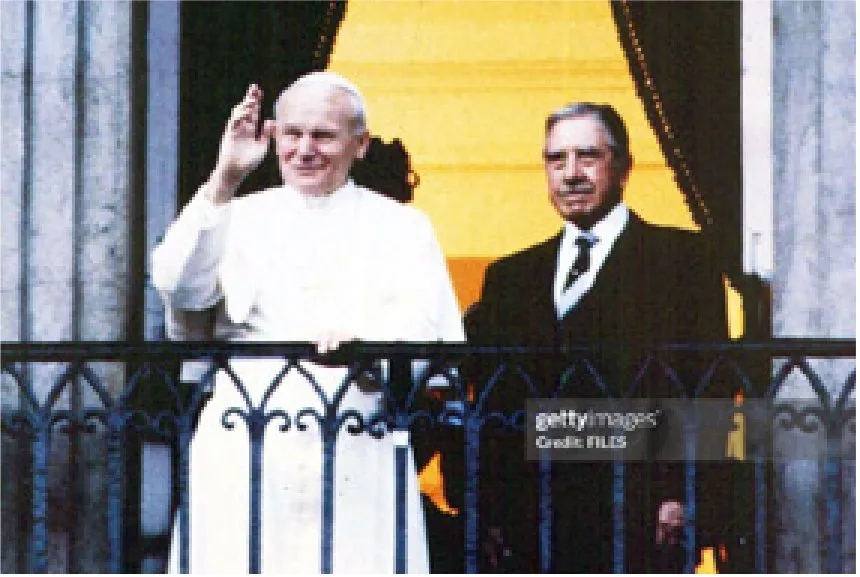
While Pope John Paul II supported human rights efforts and the democratization of Chile, he still maintained a reconciliatory and non-confrontational attitude towards Pinochet and the junta during his visit in 1987, creating divides within the Church. While the pope was the most powerful leader in the Catholic Church hierarchy, his influence on the people of Chile and the junta was limited to this visit, marking the complex, yet smaller role he played in the Church’s relation with the Pinochet regime. On April 1st, the pope flew from Rome to Chile: with his slogan being “El amor es más fuerte” (love is stronger). The goal of this pilgrimage was to reconcile the division between Pinochet’s junta and the Catholic Church as well as express a message of peace, especially during a politically tense period of time with increased disappearing and kidnappings by the junta as well as an attempted assassination and attacks by the Communist-marxist guerrilla organization Manuel Rodriguez Patriotic Front (FPMR) from 1986 to 1987. At first, the Pope recognized the work of the Vicariate of Solidarity, founded by Silva in 1977, for its “devotion on behalf of human rights”. On the second day, in his speech to a conference of 31 Chilean bishops, he “affirmed the rights of people everywhere to take part in political life and elect their leaders”, Washington Post stated on April 3rd, 1987. Despite these papal indications of support towards those who oppose the junta, he balanced this support with suggestions for the church to take a non-confrontational approach, his cordiality with Pinochet, and even his backing for some of the junta’s policies. While promoting free elections on his second day, the Pope also “advised his bishops to refrain from engaging in politics”, emphasizing that the church “identifies with no political party,” according to the Washington Post. United Press International (UPI) also headlined their article on April 11th, 1987, “Pope avoids confrontation with Pinochet.” Both sources suggest that instead of publicly condemning Pinochet, the pope took a more cautious, mediation-based approach towards interacting with the regime and encouraged the Church to do the same. During the six-day visit, the pope also directly met Pinochet, with a symbolic appearance of the pope and Pinochet, “dressed in a civilian suit, smiling and standing one step behind him.” The pope also offered prayers for Pinochet and his family after their conversation, displaying non-confrontational cordiality to the general.
Finally, the pope voiced his support for Pinochet’s anti-communist beliefs, concurring with the denunciation of “foreign influences” that are “distort[ing] the national will.” Hence, most of the Pope’s actions during his visit expressed and encouraged a cautious attitude towards Pinochet and the junta, despite somewhat supporting the work the Chilean Catholic Church has done. Still, this visit to Chile, spanning only six days, albeit important, did not contribute to the division within the catholic church quite as significantly as the two domestic cardinal archbishops, simply echoing the attitude of Cardinal Fresno’s Chilean Catholic Church and his stance towards the regime.
For the final five years of the regime, from 1983 to 1988, even with increasing human rights violations, Cardinal Fresno, similar to the pope, played the role of a cautious and steadfast conciliator between the church and the regime. Cardinal Fresno, a respected moderate and former archbishop of La Serena, Chile, succeeded Cardinal Silva in June of 1983. Even leading up to this moment, there continued to be an immensity of human rights abuses, such as the detention of “some 200 protestors” within a day on December 19, 1982, and “more than 1,000 people [who] were reportedly detained” in the months leading up to December. Though Cardinal Fresno “affirmed his support for programs such as the Vicariate of Solidarity”, he refrained from denouncing Pinochet or directly condemning the human rights abuses of the junta. While the military government’s attacks continued, anti-government protests in Chile also increased, exactly when Fresno was appointed Cardinal during the summer of 1893. Instead of directly supporting these protests, Cardinal Fresno sponsored “a dialogue between government officials and moderate opposition leaders”, specifically between the newly appointed Minister of Interior, Sergio Jarpa, himself and the Democratic Alliance. However, soon, his mediation attempt failed as Jarpa and other government officials resigned amid a government crisis. Still, Fresno continued his role as a mediator in early 1985, after some bishops agreed in late 1984 to help unite political parties. He continued to hold “bilateral meetings with selected party leaders on the subjects of reconciliation” secretly in his residence, involving former president Eduardo Frei’s cabinet member Sergio Molina, former Minister of Treasury Fernando Leniz, businessman Jose Zavala, Christian Democrat Patricio Aylwin, and president of Chilean Senate Gabriel Valdes. Together, instead of directly opposing the junta, they drafted a document named “the National Accord on the Transition to Full Democracy”, which was made public on August 26th, 1985. The Accord avoided many “controversial” subjects, such as acknowledging human rights violations and the calling for trial for those who committed these abuses, revealing the cautious and more conservative stance of its leader, Cardinal Fresno. Although not as direct, active, or forceful as Cardinal Silva, Cardinal Fresno still played a dominant role, amid human rights abuses, attacks, and a government crisis, in facilitating non-confrontational reconciliation between the church, the junta, and the general Chilean society from 1983 to 1988.
In the end, the contrast between Cardinal Silva’s active and directly confrontational work for human rights and to resist the regime from 1973 to 1983 with the cautious and conciliatory stances of both the Pope in 1987 and Cardinal Fresno from 1983 to 1988 created a major shift in the Church’s relationship to the Pinochet regime. Looking back at the hierarchy of the Catholic Church, it is intriguing how the impact of both Cardinal Silva and Cardinal Fresno largely outweighed that of Pope John Paul, who is considered the most influential for all catholics and catholic churches. Even more fascinating is that the division between mediators and adversaries in the church did not weaken its influence. Instead, despite taking different approaches, Silva’s being an active advocate for the people while Fresno’s being a private conciliator for reconciliation, both of their stances and actions contributed largely to success of the impending plebiscite in the “vote no” movement that ended the fifteen-year dictatorship in 1988, propelling Chile into an era of democracy and freedom.
Figures
Citations
- AFP. Chile-Pinochet 5. Photograph. Getty Images, April 2, 1987. Accessed November 9, 2024. https://www.gettyimages.com/detail/news-photo/this-02-april-1987-file-photo-shows-then-chilean-president-news-photo/1833770023?adppopup=true.
- Allen, Eli. “From Private Diplomacy to Public Denunciation: The Catholic Church in Pinochet’s Chile.” Master’s thesis, Wesleyan University, 2009. Accessed November 9, 2024. https://digitalcollections.wesleyan.edu/object/ir-606.
- “Another Bishop Speaks Out.” WikiLeaks. Last modified may 20, 1974. Accessed November 9, 2024. https://wikileaks.org/plusd/cables/1974SANTIA02747_b.html.
- Boadle, Anthony. “Pope Avoids Confrontation with Pinochet.” UPI (Washington, D.C.), April 11, 1987, News. Accessed November 9, 2024. https://www.upi.com/Archives/1987/04/11/Pope-avoids-confrontation-with-Pinochet/8894545112000/.
- Bowers, Steven R. “The Dual Role of the Chilean Church.” World Affairs 151, no. 2 (1988): 51-58. Accessed October 27, 2024. https://www.jstor.org/stable/20672164.
- Cheney, David. “Current Dioceses in Chile.” Catholic Hierarchy. Last modified June 21, 2024. Accessed November 9, 2024. https://www.catholic-hierarchy.org/country/dcl2.html.
- Editors, Encyclopedia. “Vicariate of Solidarity.” Encyclopedia. https://www.encyclopedia.com/humanities/encyclopedias-almanacs-transcripts-and-maps/vicariate-solidarity#:~:text=In%20one%20 year%2C%20its%20 facilities,most%20 trusted%20 institutions%20i%20 Chile.
- Fuller, Ben. “Pinochet and the Catholic Church.” Interview. Forging Memory. St. Lawrence University. Last modified April 11, 2018. Accessed November 9, 2024. https://www.forgingmemory.org/narrative/pinochet-and-catholic-church.
- Graham, Bradley. “Pope Tells Chile’s Bishops to Press for Free Elections.” The Washington Post (Washington, D.C.), April 3, 1987, News. Accessed November 9, 2024. https://www.washingtonpost.com/archive/politics/1987/04/03/pope-tells-chiles-bishops-to-press-for-free-elections/ae4d8490-92c1-4e45-a638-7b427e037bc3/.
- Kandell, Jonathan. “Bishops in Chile Denounce Junta.” The New York Times (New York, NY), April 25, 1974, News. Accessed November 9, 2024. https://www.nytimes.com/1974/04/25/archives/bishops-in-chile-denounce-junta-special-to-the-new-times-they-say.html.
- Krause, Charles. “Chilean Church Group Mixes Charity With Challenge to Junta on Rights.” The Washington Post (Washington D.C.), October 6, 1978, News. Accessed November 9, 2024. https://www.washingtonpost.com/archive/politics/1978/10/07/chilean-church-group-mixes-charity-with-challenge-to-junta-on-rights/69d1705d-2d38-41c0-9e83-7cf74cbfd00b/.
- MacEoin, Gary. “Chile’s Silent Church.” Common Weal Magazine, July 18, 1975. Accessed November 9, 2024. https://www.commonwealmagazine.org/chiles-silent-church.
- Mazurczak, Filip. “Remembering St. John Paul II’s controversial 1987 pilgrimage to Chile.” The Catholic World Report. Last modified January 14, 2018. Accessed November 9, 2024. https://www.catholicworldreport.com/2018/01/14/remembering-st-john-paul-iis-controversial-1987-pilgrimage-to-chile/.
- Meacham, Carl. “The Role of the Chilean Catholic Church in the New Chilean Democracy.” Journal of Church and State 36, no. 2 (1994): 277-99. Accessed November 9, 2024. https://www.jstor.org/stable/2399382.
- Schumacher, Edward. “CHILE IMPROVES HUMAN RIGHTS RECORD but IS IT GOOD ENOUGH?” The New York Times (New York, NY), January 2, 1983. Accessed November 9, 2024. https://www.nytimes.com/1983/01/02/weekinreview/chile-improves-human-rights-record-but-is-it-good-enough.html.
- Silva Henríquez, Raúl. “Memorias.” In From Private Diplomacy to Public Denunciation: The Catholic Church in Pinochet’s Chile, by Eli Silva Allen, 44-45. Middletown, CT, 2009. Digital file.
- Suro, Roberto. “Pope, on Latin Trip, Attacks Pinochet Regime.” The New York Times (New York, NY), April 1, 1987, News. Accessed November 9, 2024. https://www.nytimes.com/1987/04/01/world/pope-on-latin-trip-attacks-pinochet-regime.html.