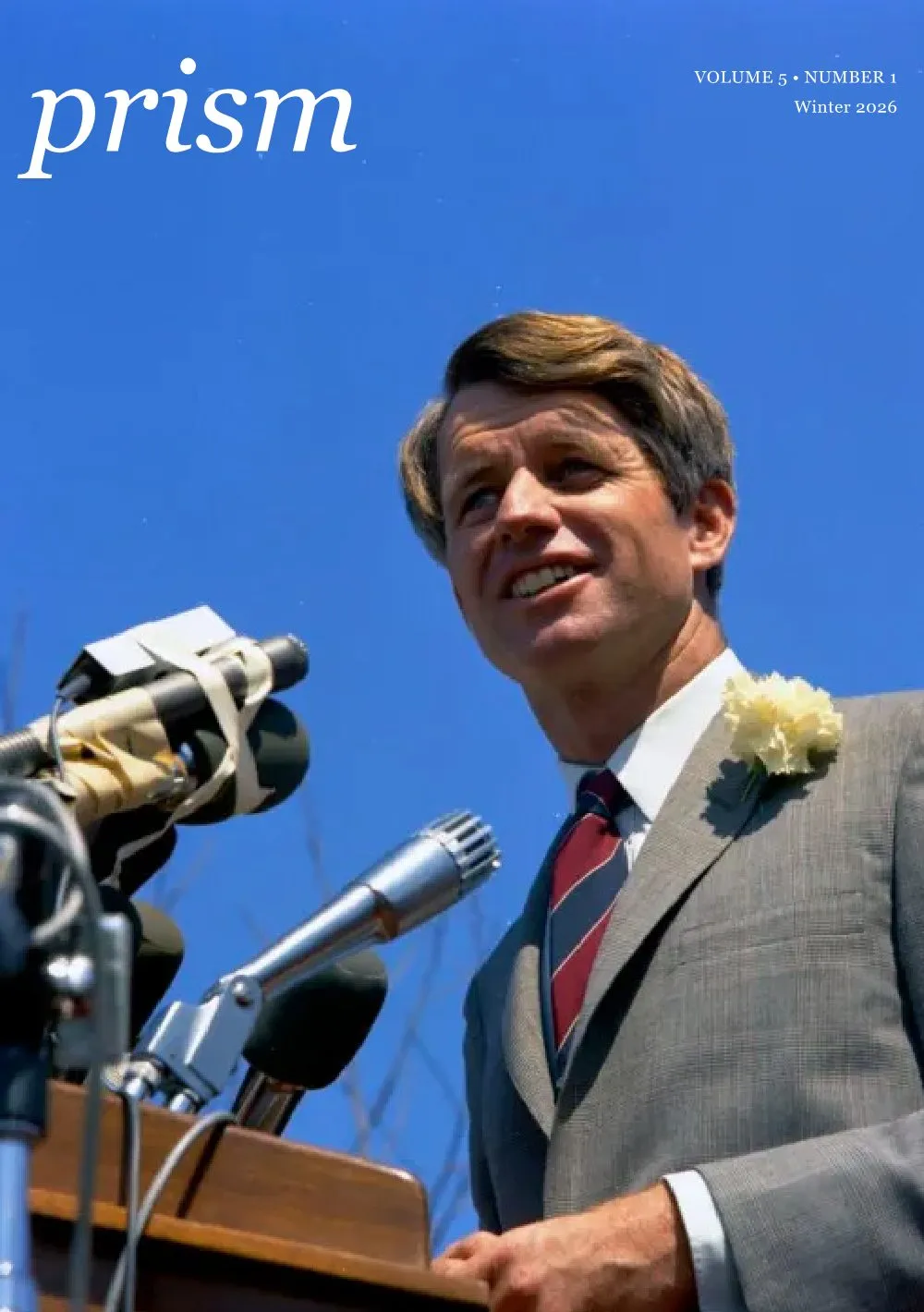
Winter 2026
Volume V, Issue I
- Published
- In this issue
- 6 papers
- 77 pages
Contents
Editor’s Note
“When you teach a man to hate and fear his brother, then you also learn to confront others not as fellow citizens but as enemies” - Robert F. Kennedy
“We can make an effort, as Martin Luther King did, to understand and to comprehend, and to replace that violence, that stain of bloodshed that has spread across our land, with an effort to understand with compassion and love.” Robert F. Kennedy
From Centre St to Pennsylvania Avenue: A Lesson on Political Violence From Robert Kennedy
By the PRISM Editor-in-Cheifs
Though the busy newscycle of 2026 has eroded discussion within the American populace, the assasination of Charlie Kirk was truly one of the most significant moments in recent American politics. Kirk was a pillar of the Republican Party, organizing and publicizing the Conservative Movement. Kirk had not attended college, viewing it to have strayed too far to the left, and self educated himself. What brought him to notoriety, however, was his famous campus tours; he would travel to college campuses and set up a table with a sign reading “ask me anything.” This method was contrasted with the modern media system, a system in which publications both on the right and left attempt to control narratives, increase polarity, and profit from shocking clips. Kirk, at a campus event on September 10th 2025, was assassinated in front of a crowd of college students at Utah Valley University. The PRISM Youth Journal takes the unwavering stance that this action, and all political violence, cannot exist in any form in our republic. It is crucial that as a nation we learn from our history, and do not slide down the slippery slope of political violence.
While this issue of political violence may seem removed from the average American, and to be a problem of our distant past, it touches many lives, and its ripples have been felt by all Americans. It has even touched the Milton Academy community this publication is based out of. Former Attorney General and Presidential Candidate Robert F. Kennedy (Milton Academy Class of 1948), spent his high school days on Centre Street as a notoriously non-conforming individual. Kennedy spent his former days at many institutions, deciding to transfer to Milton from St. Paul’s school. His Father, Ambassador Joseph Kennedy, recommended Milton as a strong institution for encouraging freedom of thought, and most importantly, being one of the primary Harvard feeder schools in the nation. Being a Kennedy meant attending Harvard, and Joe decided Bobby was destined to continue that legacy. Upon arriving at Centre St, Kennedy was noted as having a non-conforming nature. He entered Milton in Class II, and mostly kept to himself in his first months. David Hackett (Class of 1949), Kennedy’s best friend and Milton Football teammate, recalled in an oral interview that Kennedy was a “misfit” as he was a Catholic attending a homogeneously Protestant school. His distinguishing characteristic, Hackett recalled, was his “determination.” Sam Adams, another peer of Kennedy at Milton, recalled that at football tryouts “[Bobby Kennedy] tore into tacking dummies as if his life depended on it.” In addition to his determination and grit, It seems that Kennedy took the school’s motto to heart. He sought to be himself, and to allow himself to have the intellectual boldness to remain outwardly Catholic in a homogeneous Protestant institution. Hackett recalled that Kennedy disliked bullying, and would step in when upperclassmen would bully underclassmen. By his senior year, Bobby Kennedy had been permitted by his father to defend his country through enlisting in the military, in no small part because of the selflessness he had developed at Milton. In his biography Robert Kennedy: His Life, Evan Thomas writes that at Milton, Kennedy realized his privilege, and began to “notice inequality in the wider world…[and developed a clear] social conscience.” This takeaway would be the main lesson Kennedy would learn at Milton, and would pave the way for his devotion to social justice.
Robert Kennedy, the politician, followed in the footsteps of Bobby Kennedy the Milton Academy senior. Kennedy viciously prosecuted the Mob, corrupt union leaders, and Communists within his tenure on the McClellan Committee (1957-1959) and as Attorney General (1961-1964). He approached these prosecutions with the same determination and moralism that he had developed playing football and fighting bullies. Kennedy’s moralism was a defining attribute of his time in public life. When his brother, President John F Kennedy was assassinated, RFK became deeply pained. He was described as having “survivor guilt” wishing that he rather than his brother has been killed. Kennedy began, at the suggestion of former first lady Jacqueline Kennedy, reading Greek dramatists and poets. One of RFK’s favorite quotes was from Aeschylus’ Agamemnon: “He who learns must suffer. And even in our sleep pain that cannot forget, falls drop by drop upon the heart, and in our own despair, against our will, comes wisdom to us by the awful grace of God.” Kennedy would reuse the quote on April 4th 1968, upon hearing the news of the assasination of Martin Luther King Jr.
RFK’s friend Ronald Steel described that “Grief helped humanize [Kennedy]...It even made him more tolerant.” Kennedy would announce the death of MLK to a crowd in Indianapolis, Indiana on April 4th 1968 in an improvised speech. He told the crowd that, rather than seeking revenge, violence, and increasing polarity, that “we” should “make an effort, as Martin Luther King did, to understand and to comprehend [others], and to replace that violence, that stain of bloodshed that has spread across our land, with an effort to understand with compassion and love.” This quote may be the best summation of what made Robert Kennedy such an important politician. Rather than capitalizing on and encouraging polarization, Kennedy encourages Americans to face violence with love, and to replace hatred with compassion. Soon after, Kennedy would face the bullets of Sirhan Sirhan at a rally in California on account of his support of Israel, and die, having preached for nonviolence, unity, and love till his last breath.
Robert Kennedy was killed for his beliefs. He would not live to see whether his message of love and unity, and his condemnation of polarization, would be achieved. Sadly, it proved to not be adopted by America. The media and President Nixon would soon go to war with one another, and the Watergate scandal would oust the President. As Nixon departed in shame, so too did the hope of a nonpolar America. Kennedy’s lesson, however, is of immense importance today. After the death of Charlie Kirk, an alarming trend of people justifying his death was seen. Many people took to social media and news channels justifying the assasination as being the logical conclusion to loudly expressing right wing politics. Sentiments such as ‘he had it coming talking like that’ and ‘he had the wrong politics’ were shockingly prevalent. While Kirk may have had political views that the left would find disgusting, this is not grounds for assasination. Those on the left must follow Kennedy and look to counter those views with love and compassion, not follow Serhan and utilize bullets. A nation divided cannot stand. Our American experiment is predicated upon the first amendment, and the freedom for Americans to voice their opinions without fear of imprisonment or death. The loss of human life for political opinions is never justified.
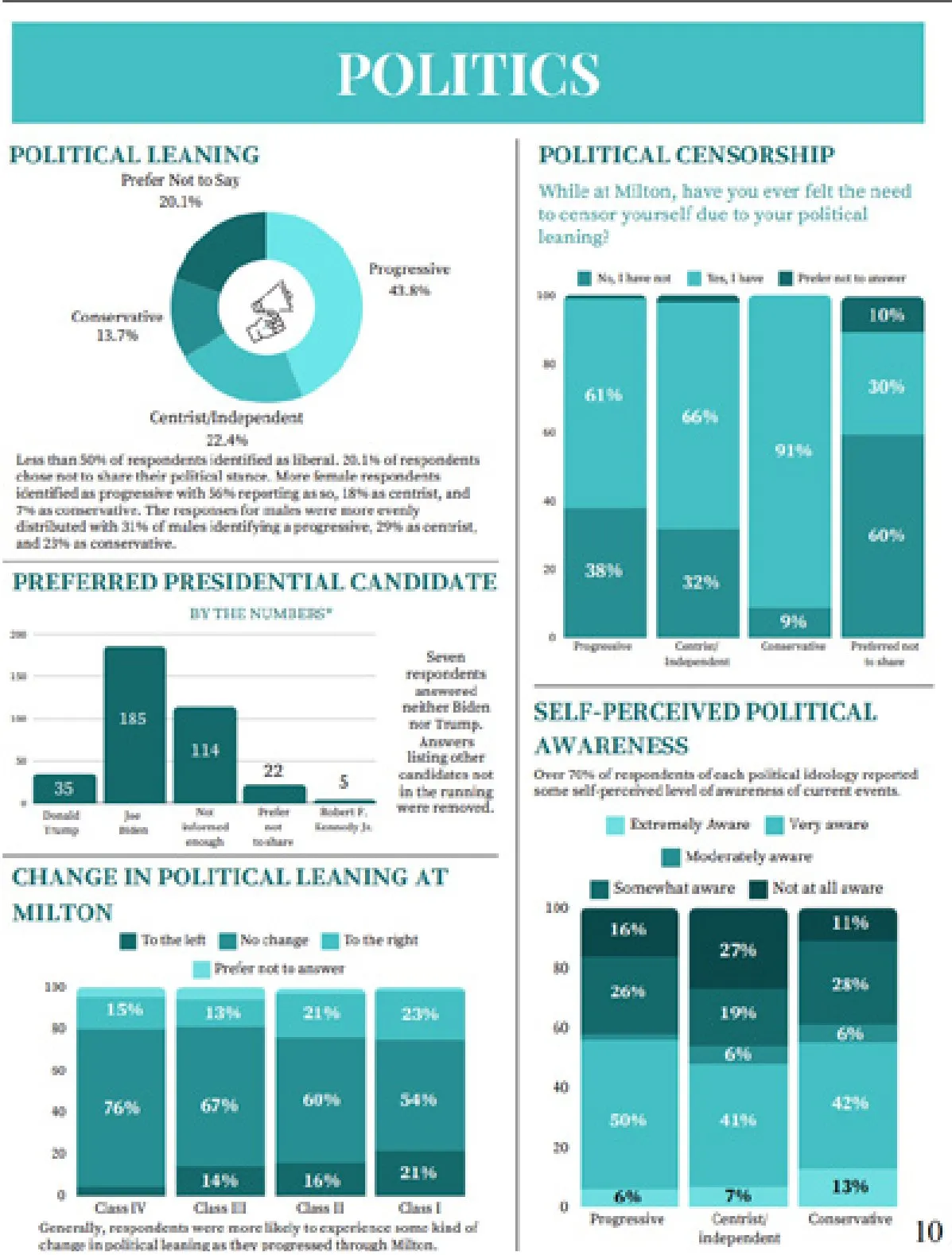
Every Milton Academy student is familiar with our beautiful motto: Dare to Be True. This motto argues that students should dare -they should courageously take the risk-to be intellectually honest and curious. Milton students, however, seem to view politics as falling outside of this dare. We approach politics as a cliche; it is implicitly assumed that people will follow the status quo, and deviation implies that that person has a problem. There is little effort to curiously and honestly listen to arguments from across political lines, and little effort to voice unpopular political opinions. The Milton Paper has an annual issue titled The State of the Academy in which data concerning questions relating to a variety of topics asked anonymously to Milton students is compiled. Among that data is questions regarding political leaning. This PRISM editorial will reference the 2024 State of the Academy, as it occurred during an election year, in which politics was within the public consciousness at a higher rate. The Milton Paper found that 20.1% of Milton Students Prefer not to list their political leaning in anonymous polling. Personal politics are such a cliche that even when anonymous, 1:5 students will abstain from revealing their political leanings. The data also showed that among “female respondents [7% identified] as conservative.” Among male respondents, this number was 23%. Nearly 1:4 men at Milton Academy were self reportedly conservative. Among these conservatives, 91% have felt “the need to censor [themselves] at Milton due to [their] political leaning.” This number is saddening, and a worrying sign that political polarization is infecting our institution. As a school with the motto Dare to be True, we have a responsibility to encourage students to think and associate freely -under the assumption that they will not harm other students. Milton has an incredibly intelligent student body with incredibly interesting minds, and it is the duty of those people to dare to voice their opinions, and to curiously, respectfully, and honestly engage with people who hold differing views. It is the duty of our institution as a whole to enable an environment in which censorship is not widespread -an environment in which those students are embraced with the love Robert Kennedy encouraged. Kennedy served alongside many Republicans in his brother’s administration, and under republican senator Joseph McCarthy. Kennedy, though he disagreed with many of the ideas of the right, sought to treat them with respect and dignity -with love. For Kennedy understood, as Abraham Lincoln dictated, that a house divided could not stand, and that only love can attempt to fix that division. He understood that the cracks in that house’s foundation would only be amplified by revenge and censorship, and sought to achieve political stability through nonviolence and compassion. As a nation, and as members of Milton Academy, we must seek to glue the foundation of our republic through the condemnation of political polarization, revenge, vilification, censorship, and most importantly, violence of all kinds.
Masthead
-
Editors-in-Chief
-
Editorial Board
-
Faculty Advisor