History
The Political Echoes of Eco-Colonialism in 1970s Sudan
Summary
Draft summaryThis paper argues that British colonial policy, driven by a doctrine of resource extraction, remade Sudan’s agriculture, water management and oil economy in ways that caused the country’s economic collapse in the 1970s and the political turmoil that followed. It uses the idea of eco-colonialism to connect the physical transformation of a landscape with a country’s postcolonial politics.
Contents
Introduction
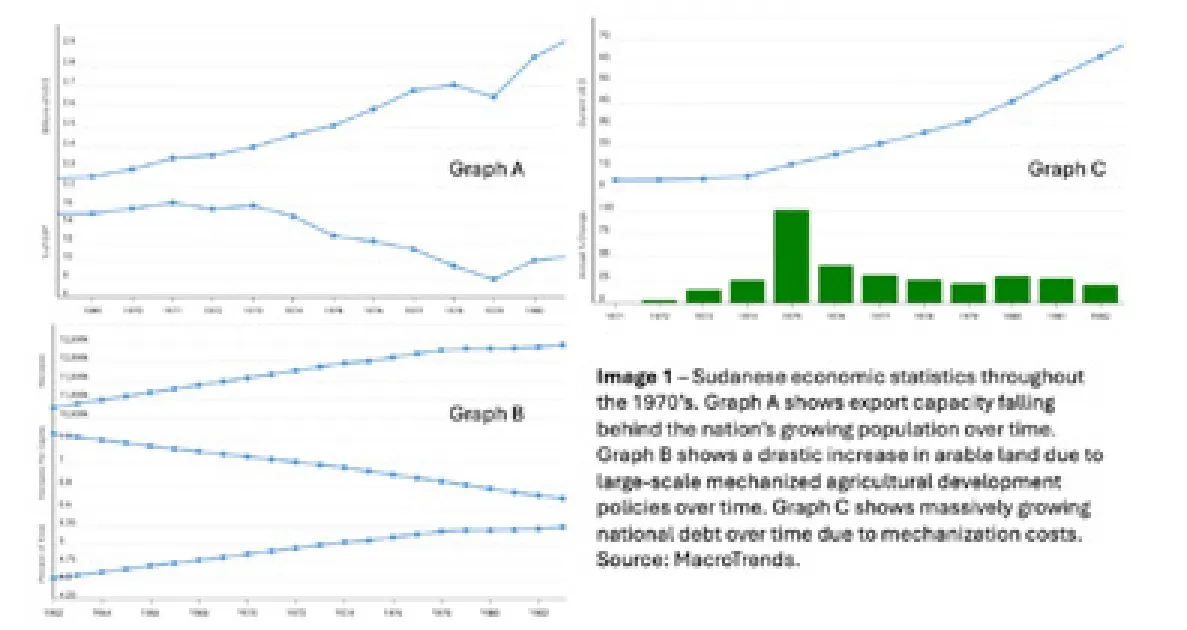
The Sudan that first gained independence from Anglo-Egyptian rule in 1956 would seem politically unrecognizable compared to the Sudan of today. Whereas the former was ruled by a reasonably democratic parliament out of Khartoum focused on domestic capacity-building and consolidation, the latter remains embroiled in one of the deadliest civil wars in the world. Though the semi-violent October Revolution overhauled Sudan’s government in 1964, the period of persistent economic decline and ethnic fracturing in the 1970s represented the defining turning point in Sudan’s journey from postcolonial democracy to humanitarian catastrophe, as it created the conditions for the Revolution of 1983, which saw the country completely shatter along ethnic lines under the weight of a brutal Sharia Law regime. Indeed, Sudan’s 1970s were characterized by falling commodity prices, rising inflation, export declines (as seen in Image 1) due to droughts, and rising economic inequality and alienation between the primarily Arab Jeballa merchant class and the Sub-Saharan African periphery. To explain the root causes of the cataclysmic 1970s, one must look to before 1956, at the Anglo-Egyptian colonial policies that shaped Sudan’s physical landscape and ethno-ecology. Colonial policies regulating agricultural exports, water management, and inter-ethnic dynamics destroyed any hope at sustainable development for the sake of resource extraction. Scholars have well documented how the legacies of settler colonialism and colonial macro-management have caused instability in continental Africa, but Sudan presents an apt case study in how extractive eco-colonialism – that is, colonialism motivated and informed by the desire to physically transform a landscape for resource extraction – can shape its postcolonial geopolitical outlook. Ultimately, the restructuring of the Sudanese ethno-ecology by British policies motivated by a colonial doctrine focused on resource extraction was the root culprit of the country’s economic collapse in the 1970s and the ensuing political turmoil.
Agricultural Policy
First, colonial-era British agricultural policy induced Sudan’s government to invest heavily in unsustainably large-scale, mechanized farming that spiraled the nation toward agricultural collapse by making the nation’s agricultural infrastructure unable to diversify from cotton exports. Cash crops were first introduced to the Sudanese region under the Ottoman regime, which reigned between 1821 and 1885. Due to the region’s fertile riverine land and access to Nile ports, growing and exporting cotton had become a staple of its informal economy by the 1890s. Thus, when the British first drew the borders around what is now known as Sudan in 1899, they saw their new colony primarily as a cash cow from which to generate increasingly lucrative cotton profits and felt little compunction to devote resources to formally administer it, as evidenced by their positioning of Egyptian Arabs as proxy administrators. Such a policy of using a proxy settler to take advantage of the land of Sudan was key as a root cause of the economic turmoil of the 1970s because it left the Sudanese with virtually no sustainable options for postcolonial growth. Specifically, British extractionism materialized in two ways. First, the British “adopted a financial and trading policy that ensured that Sudan’s export earning were always more than the value of its imports,” while keeping any export surpluses, preventing Sudanese farmers from enriching themselves or importing to invest in domestic education or infrastructure and thus precluding farmer skill diversification and perpetually ensuring upward immobility for the black African farmers. Secondly, the British created the Gezira Scheme, a massive 2,700-mile irrigation project by the British which ensured that the very agricultural infrastructure of Sudan was singularly shaped around exporting cotton. In sum, a salient result of British policies was that Sudan’s agricultural sector – its farmers and its land – literally could not physically support a path for development independent of simple cotton farming, a reality that set the stage for Sudan’s post-independence agricultural policy.
Specifically, Sudan’s governments in the 1960s and 70s sought economic growth amidst their newfound independence, but – as a result of the aforementioned colonial policies – could do so only by unsustainably expanding their cotton trade. Seeking to stimulate cotton production, the Sudanese government – itself dominated by the Arab bourgeois merchant class known as the Jeballa – allocated large plots of land previously owned by black subsistence farmers to absentee merchants and politicians while taking loans from the World Bank to mechanize agricultural production. As a result, the size of arable land developed increased drastically throughout the decade, as seen in Image 1, and, by the end of the 1970s, a whopping 4 million feddans stretching across the nation were reserved for mechanized agriculture, all to support mere thousands of largely absentee farm owners at the expense of the land of the millions of traditional subsistence farmers. As a side note, archival evidence suggests that this mechanization process was not only the indirect effect of British ecological management but also directly sponsored by the British regime, as “60 percent of the mechanised farms set up in the 1950s were unauthorised, indicating that the practice had been ongoing for at least half a century”. Problematically, to finance mechanization, the Sudanese government depleted its reserves and resorted to deficit spending and foreign borrowing from the World Bank in particular. As a result, the country’s national debt shot through the roof – by 1344% – between 1970 and 1980, as seen in Image 1. Excessive debt financing pushed Sudan into an inflationary spiral; thus, the potential of bolstered agricultural exports to save their currency became their only hope of economic recourse. Devastatingly, agricultural mechanization did the exact opposite: initially induced by the British drive for resource-extractive governance, it led to the nation’s economic collapse in the 70s in two specific ways.
First, mechanized farming simply exceeded the land’s physical carrying capacity, leading to unstable cotton production throughout the 1970s. While the subsistence economy prior to mechanization used low-technology techniques that “preserved soil fertility” and “exploited rangeland in a rational fashion,” mechanization, by precluding the use of these techniques, ensured mass desertification via soil erosion, land degradation, and deforestation. Moreover, new farms often cut through the routes used by pastoralists to move their livestock between seasonal pastures, debarring the soil-sustainable practice of seasonally mobile grazing, further contributing to soil degradation. Thus, while cotton production overall increased throughout the 70s, it was unstable due to increasingly severe droughts, which introduced cyclical economic downturns that prevented any meaningful economic growth. Moreover, while Sudan’s export volume grew throughout the decade, it failed to keep pace with a rising population, as seen in Image 1, and thus could not support the nation’s economic needs. Ultimately, mass mechanization spiraled out of control as land originally not to be touched was demarcated for mechanization by a government increasingly desperate for private sector growth, in turn hampering production and growth even further and necessitating more land transfers; thus began a vicious cycle of mutually reinforcing agricultural and economic stagnation.
Secondly, the fruits of increased agricultural output served only to alienate the rural periphery, as mechanization necessitated the displacement of indigenous farmers, enshrining rising wealth inequality and social unrest. To make way for conglomerate farms, “small producers increasingly had their lands expropriated, and were progressively incorporated into market relations as wage labourers,” a phenomenon with both socio-cultural and economic consequences. Socio-culturally, the development of privatized wage relationships represented a cosmopolitan “new form of social differentiation” that replaced the old patronhood-based relationships that characterized subsistence economies. In other words, the rural periphery was increasingly proletarianized in relation to the Arab Jeballa Bourgeoisie, a relationship which socially disenfranchised the primarily African new proletariat who felt left behind by evolving norms, as evidenced by the formation of Southern separatist movements during this era. Microeconomically, on the other hand, the replacement of subsistence incomes with wage income meant that farmer families were increasingly unable to support their livelihoods, and poverty dramatically shot up during the period. To make things worse, the Jeballa merchants who invested in mechanization primarily “raised capital through mortgageable property or other assets in the urban centers,” increasing property prices and further impoverishing the workers. Macroeconomically, the expansion of commercial farms westward drew away scarce farmworkers from the north, creating labor deficits in the north that increased overall costs and precipitated spending collapse. Of course, these economic effects only exacerbated the aforementioned social alienation. In all, mechanization displaced black subsistence farmers from their land and forced them into novel wage relations that disrupted traditional social hierarchies and ensured rising inequality and economic collapse. A convergence of this rising poverty and macroeconomic distortion with crop failure – all at the root caused by British extractionist export policies – drove Sudan’s economy off the cliff the mounting debt had put it on and into the turmoil it experienced in the 1970s.
Water Management
Secondly, in simultaneously enshrining an extractionist water management doctrine and Egyptian primacy, British policy led to Egyptian water management programs that exacerbated ethnic tensions and agricultural failures in Sudan. The Sudanese have, throughout their history, been almost entirely dependent on their access to the Nile for agricultural irrigation and for transportation. Despite this dependency, British regional authorities have delegated the administration of Nile water primarily to the Anglo-Egyptian authority and its successors, with little consideration of Sudanese welfare. A desire to streamline and bureaucratize commodity extraction motivated this arrangement; as Barbara Casciarri of the University of Paris points out in her book Multidimensional Change in Sudan, “water resources in Sudan have been targeted as part of a more general “great transformation” seeking to turn common spaces, goods, and rooted local forms of communal ownership and management into marketized commodities”; for the British, the best way to do so was to centralize administration as much as possible, while the Egyptians represented a perfectly situated proxy. The colonists themselves concurred: Colin Moncrieff, a British administrator who worked on irrigation projects in Egypt in the 1880’s and 1890’s, wrote in a geographic survey of Sudan that “the derelict estate” of Sudan could only produce “money” for the British should it be “irrigated” and optimized to produce “abundant harvests”, reflecting the British attitudes of developmentalist macro-management and extractionism. British management of Nile water began in 1907, when Sir William Garstin proposed plans for a canal to divert water from the Sudd wetlands of South Sudan to the Egyptian-ruled north for agricultural purposes, to be named the Jonglei Canal. Though the Jonglei began construction only in the 1950s and was never completed, it represented an early symbol of the British “civilizing mission”, prospecting water loss, disease, and flooding in the subsistence-based South for the sake of colonial macro-development. The British began laying the groundwork for later Egyptian projects in 1920, when civil engineer and politician Murdoch MacDonald published his Nile Control scheme for the Ministry of Public Works. MacDonald’s proposed a plan to consolidate and streamline regional water resources, named the “Century Storage Scheme”. MacDonald’s plan would see the water resources of the entire Nile river basin managed collectively to serve British objectives for the region – primarily cotton cultivation – as a whole, as opposed to as individual sub-regions, each with differentiated relationships and uses of the water. Problematically, however, both Egyptian and British objectives for Nile water revolved around industrial projects, like large-scale agriculture and – later in the 20th century – nationwide mechanized water supplying, thus benefiting from efficient macro-management. Sudanese uses primarily involved sustainable subsistence agriculture. Naturally, MacDonald’s plan heavily favored the former interests, a bias with reverberations across the next century. Indeed, the core idea of the Century Storage Scheme was passed down across generations of Anglo-Egyptian administrations, shaping the way Arab governors from Egypt and Sudan treated Nile water management long after both nations gained independence.
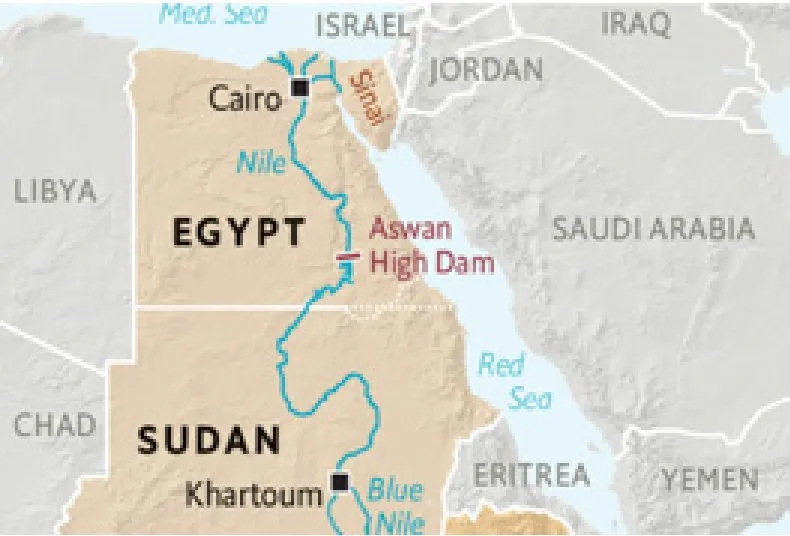
This kind of water management has led to disastrous consequences for Sudan’s ecology and, subsequently, its economy down the line. Perhaps most saliently, in 1959, the recently independent Sudan faced demands from then-Egyptian President Gamal Abdel Nasser to allow the latter to build his flagship nationalist project in the Aswan High Dam, which was projected to displace tens thousands of Nubians through flooding and increasing regional soil salinity and water-logging, as seen in Image 2; Nasser meant for the dam to secure full Egyptian control over its own water flows, as the nation was 98% dependent on Nile water resources. The then-Sudanese government opposed Nasser’s plan and preferred instead a renewed version of MacDonald’s Century Storage Scheme, involving a series of smaller irrigation projects across Southern Sudan, including the Jonglei Canal and the Roseires Dam, primarily in order to secure nationwide hydroelectricity. While the two nations preferred opposing plans, both plans would have been partially funded by the then-International Bank for Reconstruction and Development (later the World Bank) with heavy British backing, both were proposed by the Arab administrators the British put in the power, and both were at their core merely different visions of the British model of basin-wide management to the end of regional “development”. Thus, they show that the British colonial water model had become fundamental to postcolonial governance in both nations. When General Ibrahim Abboud deposed the Sudanese government in 1958, his new administration consented to the construction of the Aswan High Dam (which was completed in 1971) and to a seemingly fair flow-sharing regime by signing the 1959 Agreement for the Full Utilization of the Nile Waters while continuing existing Century Storage Scheme-esque projects in the South. While scholars mostly agree that the agreement reached in 1959 was a diplomatic success, the combination of both nations’ irrigation schemes had the effect of drastically eroding Sudan’s ecological health. For one, the wave of irrigation projects did devastating damage to the Nile river bed, reducing biodiversity and increasing water contamination, in turn harming riverside communities directly dependent on Nile water. Moreover, the Aswan High Dam directly displaced over 100,000 Nubians living along the Egyptian-Sudanese border in what was known as “The Nubian Exodus” due to the creation of the new Lake Nasser reservoir. These ground-level effects were felt greatest near where the most intense project were build – Nubian communities in the Sudanese northeast, near the Aswan Dam, and black subsistence communities in the Southern wetlands, near the Roseires Dam; thus, the projects exacerbated ethnic tensions and proletarian alienation, the former of which often spilled over to localized violence and insurgency movements in the 1970s. Aside from direct human impacts, the dams permanently altered the region’s soil: it disrupted the cycle of sedimentation and increased soil salinity, slowing soil replenishment in near-riverian agricultural communities while forcing farmers to use crude chemical fertilizers that only decreased soil fertility to replace the silt the Nile flow used to provide. These agricultural effects made the Sudanese agricultural industry devastatingly vulnerable to crop failure during its downturns in the 1970s, drastically contributing to the nation’s overall economic woes.
Oil Colnialism
Thirdly, the British separation of a more developed Arab north and a less developed black South, coupled with postcolonial attempts at exploiting Sudan’s oil resources, ensured violent North-South civil conflict. The union of Northern and Southern Sudan under one state was, from the very start, an artificial imposition by the Anglo-Egyptian administration. Prior to the colonial period, the people of Southern Sudan overwhelmingly identified with the clan-based cultures of East Africa, while those of the North considered themselves Egyptian and identified with the cultures of the Middle East. In an attempt to develop Sudanese land while minimizing resource expenditure, the British streamlined governance by administering the region as a whole. As a result of this arrangement, the culturally and socially distinct Northern and Southern Sudanese were tied together for post-independence development. Indeed, as British Governor General Hubert Huddleston wrote in a post-independence exit report, “the peoples of the Sudan are distinctively African and Negroid, but the geography and economics combine to render them inextricably bound for future development to the Middle Eastern and Arabicized Northern Sudan”. While politically bound together, the two groups remained socio-culturally divided: through British policy, the North-South dynamic had become the main social identity for most Sudanese. As Mahmood Mamdani of Columbia University writes in his book Neither Settler nor Native, “the North-South divide seeped into the consciousness of the so-called Arabs and so-called Africans, until it came to seem the natural order of things.” British policy lay at the root of this antagonism as it enshrined a power imbalance along ethnic lines: because the Egyptians had been a British colony since 1882 and thus had bureaucrats familiar with British-style governance, the British placed primarily Northern Egyptophile Arabs in positions of power. Arabs throughout the first half of the 20th century were given not just federal power but institutional power at every level of society. Throughout both the North and the South, Northerners became “administrators, senior officers in the army and police, [and] teachers in government schools,” while enjoying far higher levels of British developmental investment. The Arabs came to not just dominate the government but also became far more educated and upwardly mobile. As a result, by the 1950s, the Arabs were far wealthier than their Southern counterparts and also controlled the nation’s macroeconomy. Moreover, the British, in order to maintain the export surplus in the South that allowed them to extract crops absent reciprocal investment, intentionally strangled trade and thus prevented economic gains from spilling over to the South, imposing the Closed Districts and Permit to Trade orders in the 1920s, which essentially created insulated Northern and Southern economies. For the same reason, the British also “encouraged Islamization and Arabization of the north through financial help for building mosques and pilgrimage travel for Muslims” while preventing the spread of Islam in the South by allowing in Christian missionaries who precluded the South from culturally identifying – and thus trading on a large scale – with the Arab states on the other side of the Bab el-Mandeb Strait. The most salient effect of this intentional underdevelopment was that the perception of rising inequality with an antagonistic group prompted Southern unrest.
This antagonism would set the stage for upcoming oil conflicts in the early 1980s. Indeed, the feeling of Southern alienation that incensed the 1983 civil war between the revolutionary Sudan Peoples’ Liberation Army (SPLA) and the Arab ruling government was built throughout the 1970s in relation to conflicting claims over oil in an increasingly oil-dependent state and enabled by various foreign interventions. Oil was first discovered in Sudan, overwhelmingly in the Southern Sudd region and the Southwestern Kordofan, in 1958, when George H. W. Bush, then a US ambassador to the UN, alerted the government of Sudan to US satellite data that indicated the presence of oil in the region. Mass oil exploitation began in the 1970s, when a Sudanese government recovering from a period of instability and beginning to reckon with agro-economic decline granted the American Chevron Oil Company license to spend about 1 billion dollars on extensive seismic testing and the drilling of 52 oil wells in an attempt to shift away from agricultural export dependency. Problematically, however, Chevron’s concessions were granted by the Northern government to exploit oil fields in the South; the former sought nationwide stability but saw no intrinsic value in preventing human violence in the South, especially not in the face of the potential for oil wealth. As a result, lax regulation allowed Chevron – backed by several successive Sudanese governments along with multinational corporations – to violently “clear” the land they were developing of its inhabitants, often involving attacks on Upper Nile communities by Sudanese government militias. Aside from direct displacement, the soil-degradative effects of oil drilling also marginalized land-dependent Southern farmers who increasingly faced little choice but violent resistance. As a result, oil became a major flashpoint for escalating North-South tensions as Southern disillusionment rose. Often, these tensions escalated into violence: as most oil fields in Sudan were “numerous and small rather than few and large”, they became targets for disenfranchised Southern armed resistance groups mobilized by Chevron’s violence; resistance sparked retaliation, and violence became cyclical. In 1980, President Nimeiri’s government broadened the resistance by ignoring vehement Southern opposition to redraw the Heglig and Unity oil fields into the province of Kordofan, enabling Chevron to begin development in those areas. Moreover, whereas Chevron had initially promised to return oil profits to Sudan in the form of private infrastructure investments in the South, convincing the Sudanese government to anticipate becoming an oil state and thus cut spending into other sectors, they reneged on these promises while the Northern government neglected to restrain their violence. As a result, the entire nation economically stagnated as the oil revenue they had become newly dependent on failed to materialize in investments that would make up for lost agricultural output. This economic stress, combined with the Southern perception of Arab-Chevron imperialism, ultimately led to war: In 1983, the SPLA, now a coalescence of smaller Southern resistance movements, attacked Nimeiri’s Islamist government, sparking a decades-long series of reciprocal insurgencies that continue to this day. Not only did the SPLA draw most of its support from disillusioned and displaced Southern farmers, the fact that their initial attacks on government infrastructure focused on the most important oil fields demonstrates that cutting Northern oil access was a strategic priority for them, signifying that by this point ethnic tensions in Sudan had become intertwined with the question of oil resource access. In other words, ethnic tensions first enshrined by British policy spiraled into conflict due to the exploitative practices involved Chevron’s attempts to extract resources and the nation’s crippling oil dependency which, in turn, was also induced by colonial agricultural and water management. Thus, British policy lay at the root of the ethnic antagonisms at the core of violence of the late 70s and the war of 1983; these antagonisms, however, were allowed to spiral into conflict only when placed in relation to natural resource access, thus demonstrating the centrality of resource-extractive colonialism in causing Sudan’s conflict.
Conclusion
The beginning of this essay claimed that recently, post-independence Sudan would seem “politically unrecognizable” compared to its modern counterpart. Perhaps the more important story, however, is told by the change in the country’s physical landscape: the Sudan of 1899, prior to British rule, would also be ecologically unrecognizable to the modern Sudanese. Half a century of colonialism has transformed much of Sudan’s Southern wetlands and Northern grasslands into arid, unusable desert, scattered with Chevron oil rigs, taking with it milenia of indigenous practices. Such drastic change did not follow an ecologically devastating war but was the intentional result of British and then American resource extraction; the instability and war came after. By fixing Sudan’s economy and agricultural sector into hopeless single-crop dependency then setting the government up for unsustainable mechanization, by disrupting the historically important Nile river flow for the sake of streamlining governance, and by turning Sudan into an ethnically divided oil state, eco-colonialism has cemented its place as the root cause of Sudan’s cataclysmic 1970s. The indirect violence of eco-colonialism, as seen in Suda,n is similar to direct colonial violence in that it has created devastating political and economic consequences for post-colonial nations but is perhaps even more indicative of the fundamental logic behind colonialism, which seeks to transform complex human landscapes into simple subjects for commodity extraction. Through case studies like Sudan, scholars can understand that violence against nature necessarily translates to violence against humans in a variety of ways. By studying the specific methods and ecological imaginaries through which eco-colonialism operates, we can then begin picturing holistic decolonial methods that account for ecological replenishment and adaptation as parallel to economic and political rebuilding.
Figures
Citations
- Ali, Ali Abdalla. “Roots of Sudanese Conflict Are in British Colonial Policies.’” Sudan Tribune. Last modified February 7, 2008. Accessed January 2, 2025. https://sudantribune.com/article25930/.
- Beshir, Mohamed Omer. Revolution and Nationalism in Sudan. New York: Barnes & Noble Books, 1974.
- “The bitter dispute over Africa’s largest dam.” The Economist. Last modified July 4, 2020. Accessed January 12, 2025. https://www.economist.com/middle-east-and-africa/2020/07/04/the-bitter-dispute-over-africas-largest-dam.
- “British Colonization of Sudan.” The Imperialization of Sudan. Accessed January 9, 2025. https://sudanesecolonialismmicdswellseblockfchal.weebly.com/british-colonization-of-sudan.html.
- Bryant, Edward K. “Environmental Impacts of the Aswan High Dam.” The Military Engineer 72, no. 467 (1980): 181-83. JSTOR.
- Carruther, William. “How Egypt’s Aswan Dam Washed Away Nubian Heritage.” New Lines Magazine. Last modified February 24, 2023. Accessed January 9, 2025. https://newlinesmag.com/essays/how-egypts-aswan-dam-washed-away-nubian-heritage/.
- Carruthers, William. “’How Egypt’s Aswan Dam Washed Away Nubian Heritage.’” New Lines Magazine. Last modified February 24, 2023. Accessed January 7, 2025. http://William Carruthers.
- Casciarri, Barbara, Munzoul A.M Assal, and François Ireton. Multidimensional Change in Sudan (1989–2011). Berghahn Books, 2015. https://doi.org/10.2307/j.ctt9qcjvs.
- “THE CHEVRON PERIOD: 1974-92.” Human Rights Watch. Accessed January 16, 2025. https://www.hrw.org/reports/2003/sudan1103/10.htm.
- Colin C. Scott Moncrieff. “Egyptian Irrigation.” The Geographical Journal 35, no. 4 (1910): 425-28. https://doi.org/10.2307/1777022.
- “Egyptian Irrigation.” The Geographical Journal 35, no. 4 (1910): 425-28. https://doi.org/10.2307/1777022.
- Conroy, F. Dennis. “United States Economic Aid to Africa: 2. Aid Program in Sudan.” African Studies Bulletin 7, no. 1 (1964): 6-11. https://doi.org/10.2307/523020.
- Duffield, Mark. “Absolute Distress: Structural Causes of Hunger in Sudan.” Middle East Research and Information Project 166 (September/October 1990). Accessed January 7, 2025. https://merip.org/1990/09/absolute-distress/.
- Johnson, Douglas H. The Root Causes of Sudan’s Civil Wars. NED - New ed. Boydell & Brewer, 2016. JSTOR.
- Khairalseed, Abd Almohsin Rizgalla. “Desertification in Sudan, Concept, Causes and Control.” ARPN Journal of Science and Technology 5, no. 2 (2015). https://fanack.com/wp-content/uploads/vol5no2_6.pdf.
- Lin, David. “The Role of British Colonial Policy in the South Sudanese Civil War: A Postcolonial Conflict Analysis.” Scholarworks @ SeattleU, June 2018. Accessed January 2, 2025. https://scholarworks.seattleu.edu/cgi/viewcontent.cgi?article=1025&context=intl-std-theses.
- Mamdani, Mahmood. Neither Settler nor Native : the Making and Unmaking of Permanent Minorities. 2022 ed. Cambridge, MA: Belknap Press of Harvard University Press, 2022.
- Metz, Helen Chapin. Sudan : A Country Study. 4th ed. Washington, DC: Federal Research Division, Library of Congress : For sale by the Supt. of Docs., U.S. G.P.O., 1992.
- The New Humanitarian. “Sudan: Rich farms, conflict and climate change.” Relief Web. Last modified May 22, 2008. Accessed January 7, 2025. https://reliefweb.int/report/sudan/sudan-rich-farms-conflict-and-climate-change.
- Patey, Luke A. “CRUDE DAYS AHEAD? OIL AND THE RESOURCE CURSE in SU-DAN.” African Affairs 109, no. 437 (2010): 617-36. JSTOR.
- Reeves, Eric. “Oil Development in Sudan.” Review of African Political Economy 29, no. 91 (2002): 167-69. JSTOR.
- Searcy, Kim. “Sudan in Crisis.” Origins. Oklahoma State University. Last modified June 2019. Accessed January 2, 2025. https://origins.osu.edu/article/sudan-darfur-al-bashir-colonial-protest.
- Shokr, Ahmad. “Hydropolitics, Economy, and the Aswan High Dam in Mid-Century Egypt.” The Arab Studies Journal 17, no. 1 (2009): 9-31. JSTOR.
- “Sudan.” MacroTrends. Accessed January 14, 2025. https://www.macrotrends.net/global-metrics/countries/SDN/sudan/population.
- Suliman, Mohamed. “Civil War in Sudan: The Impact of Ecological Degradation.” Environment and Conflicts Project @ Institute For African Alternatives. Accessed January 7, 2025. https://www.africa.upenn.edu/Articles_Gen/cvlw_env_sdn.html.
- Tekuya, Mahemud. “The imperialist past that started dam politics between Egypt, Sudan and Ethiopia.” The Conversation. Last modified March 21, 2021. Accessed January 9, 2025. https://theconversation.com/the-imperialist-past-that-started-dam-politics-between-egypt-sudan-and-ethiopia-156760#:~:text=Nasser%20wanted%20to%20build%20a,border%20between%20Sudan%20and%20 Egypt.
- “TimesMachine.” In the New York Times. Previously published as “Sudan Retains US Aid.” New York Times (Khartoum), November 20, 1958, 40. Accessed January 2, 2025. https://timesmachine.nytimes.com/timesmachine/1958/12/02/92660079.html?pageNumber=40.
- USAID. A Climate Trend Analysis of Sudan. Accessed January 10, 2025. https://pubs.usgs.gov/fs/2011/3072/pdf/FS2011-3072.pdf.
- “Who owns the water of the Nile?” We Are Water Foundation. Last modified November 2, 2023. Accessed January 7, 2025. https://www.wearewater.org/en/insights/who-owns-the-water-of-the-nile/.
- Wise, Louise. “The Genocide-Ecocide Nexus in Sudan: Violent ‘Development’ and the Racial-Spatial Dynamics of (Neo)Colonial-Capitalist Extraction.” Journal of Genocide Research 23, no. 2 (2021): 189-211. https://doi.org/10.1080/14623528.2021.1887057.