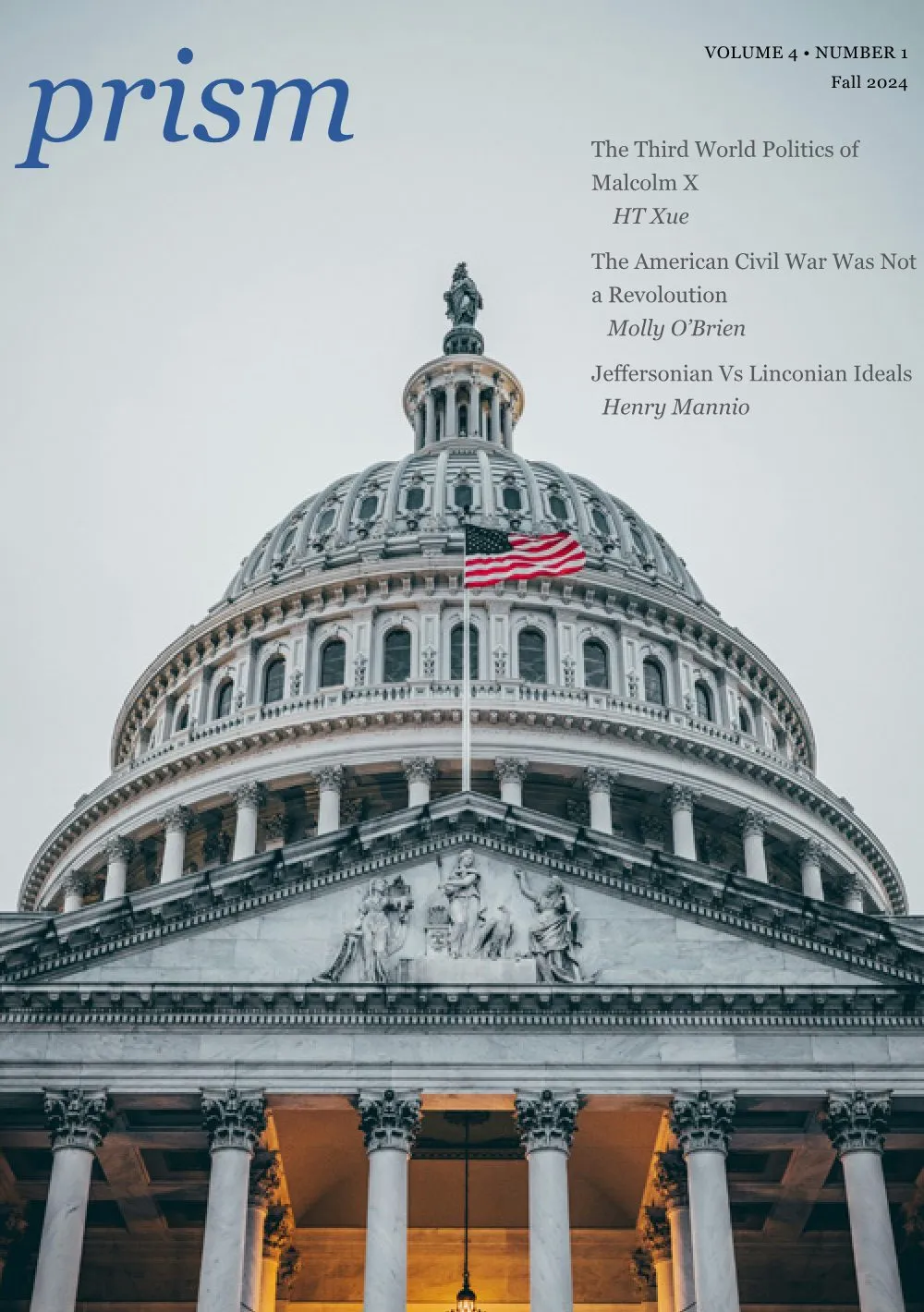
Fall 2024
Volume IV, Issue I
- Published
- In this issue
- 12 papers
- 115 pages
Contents
Editor’s Note
“Democracy is a process, not a static condition. It is becoming, rather than being. It can easily be lost, but never is fully won. Its essence is eternal struggle.”
—- Federal Judge William H. Hastie
When thinking of utopia, few leave out democracy from the world they imagine. Indeed, history is filled with people who, despite promising radically different visions of how the world should work, are united in their claims to want to give power to the people – from Thomas Jefferson to Mao Ze Dong, from the 2018 Yellow Vest Protestors in France to the 2024 pro-reform protestors in Georgia. Democracy draws its universal appeal and its power from its very nature; it serves the interests of the masses and thus comes in fundamental tension with the interests of those who seek to consolidate resources or power, of whom history has seen many. Thus it can be argued that the fight for the people to keep their power in the face of a powerful elite – in other words, the struggle for democracy – is the fundamental driving force of history.
But what is democracy in the first place? Where did it come from? To the first question, some might answer that democracy is a system in which people vote, others might answer that it is the natural final stage of a society’s evolution toward equality. To the second question, some might suggest that the Ancient Athenians invented democracy, while others might point to the first European parliamentary systems as humanity’s first exercise in democracy. Translated from its Greek roots, the word “democracy” means “rule by the people”. By this definition, democracy has existed since long before even the first organized governments. It is not a system of government, nor a stage of human development, but rather a reality of life. Every human who has ever lived in history has made decisions that affected the world around them, and the world is in terms the product of the gross sum of every human decision ever made. Democracy is the term used to describe this reality. Democracy was present in pre-agriculture hunter-gatherer communities in Sumeria, it was present in every popular revolution, it is present in every worker’s strike, and it is present today in all the interactions in the world around us. Sometimes, despots and autocrats weaken the power of democracy, and people always fight to preserve it, but its existence is a fact of life. Democracy gives weight to our choices, and thus frees us to shape our world, but also binds us to live by the consequences of our choices.
The 2024 US presidential election represented an upheaval in democracy, but one that is far from unprecedented. While America deals with the fallout of a transition of power, Israel, Georgia, Taiwan, and many other countries reckon with similar disturbances. Moreover, presidential elections in 2020 and 2016, the birth of a nation in 1776, the collapse of the Aztec empire in 1521, and the passage of the Voting Rights Act in 1965 all represent major changes in the democratic fabric of our country.
All of this is to demonstrate that democracy, along with its many turbulences, is a feature, not a bug of history. That’s why this issue of Prism Youth Journal, in light of the recent election, compiled history papers concerning upheavals in not just democracy in America, but democracy as a value and a way of life to hopefully help you better understand what it means to live by our – the people’s – own power. Henry Mannino’s (Milton Academy ‘26) paper Jeffersonian Vs Jacksonian Ideals details the methods and motivations by which democracy was denied to formerly enslaved people during the Reconstruction era. Enslavement, Abortion, and “Race Suicide” by Emilia Raviola (Milton Academy ‘26) argues that reproductive control was a key avenue by which agency was denied to America’s earliest victims of despotism. Anaïs Bricout’s (Milton Academy ‘26) The True Public Enemy outlines how men in power use populism and scapegoating as a means to turn the might of democracy against its very own constituents. These, along with ten other papers from students at Milton Academy, Bridgewater-Raynham High School, and Barrington High School collectively explore small corners of the grand historical battle between democracy and that which seeks to suppress it. Some papers talk about democracy explicitly, while others require the reader to do some thinking of their own, and they all vary in length, tone, and content. Regardless, we are confident that you will learn something new from each of them, and we hope you enjoy this issue of Prism Youth Journal!
Yours Sincerely,
The Editors-In-Chiefs
Molly and HT
Masthead
-
Editors-in-Chief
-
Editorial Board
-
Faculty Advisor